PetNutriFactory – Leading Chinese Manufacturer of Custom Pet Nutritional Supplements
- We specialize in the OEM & ODM design and manufacturing of custom pet nutritional supplements.
- We specialize in the OEM & ODM design and manufacturing of pet nutritional supplements. Our professional R&D and production team is dedicated to providing fully customized nutrition solutions for global pet brands.
1. Customized Nutrition Solutions
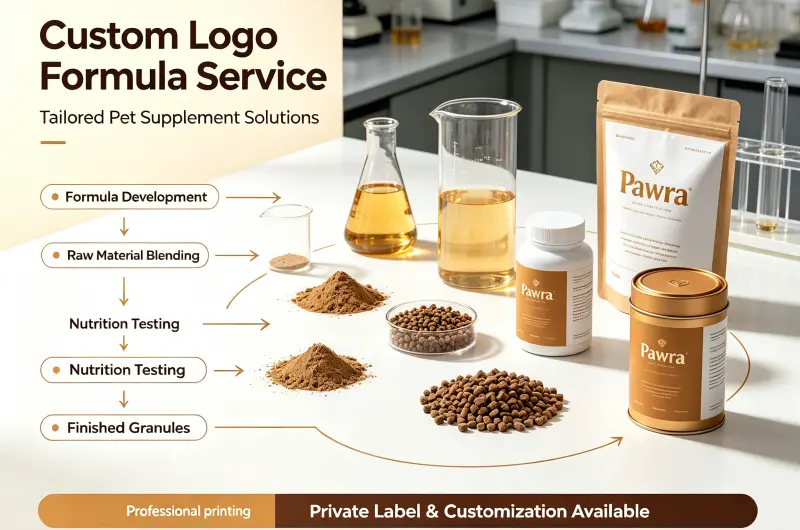
- Custom Formula & Raw Material Selection for Different Pet Health Needs
- Personalized Flavor & Label Design to Match Your Brand
- Tailored Dosage & Potency for Specific Pet Groups
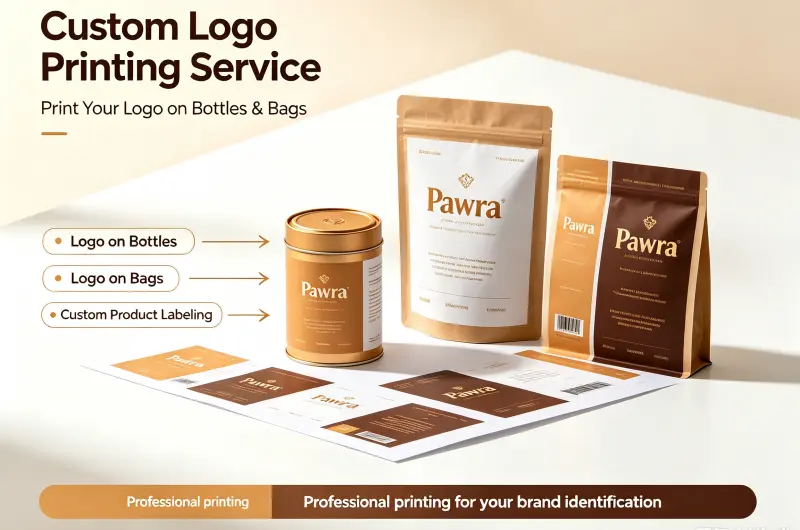
- Private Label Logo Printing & Packaging Customization
- Custom Product Specification & Outer Packaging to Enhance Brand Value
1. OEM and ODM Services
- Customized Logo & Label Printing for Brand Identification
- Personalized Flavor & Formula Customization for Brand Consistency
- Professional Packaging Design to Upgrade Product & Brand Value
- Tailored Supplement Dosage & Specifications for Various Market Needs
- Professional Raw Material & Formula Development for Safe & Reliable Efficacy
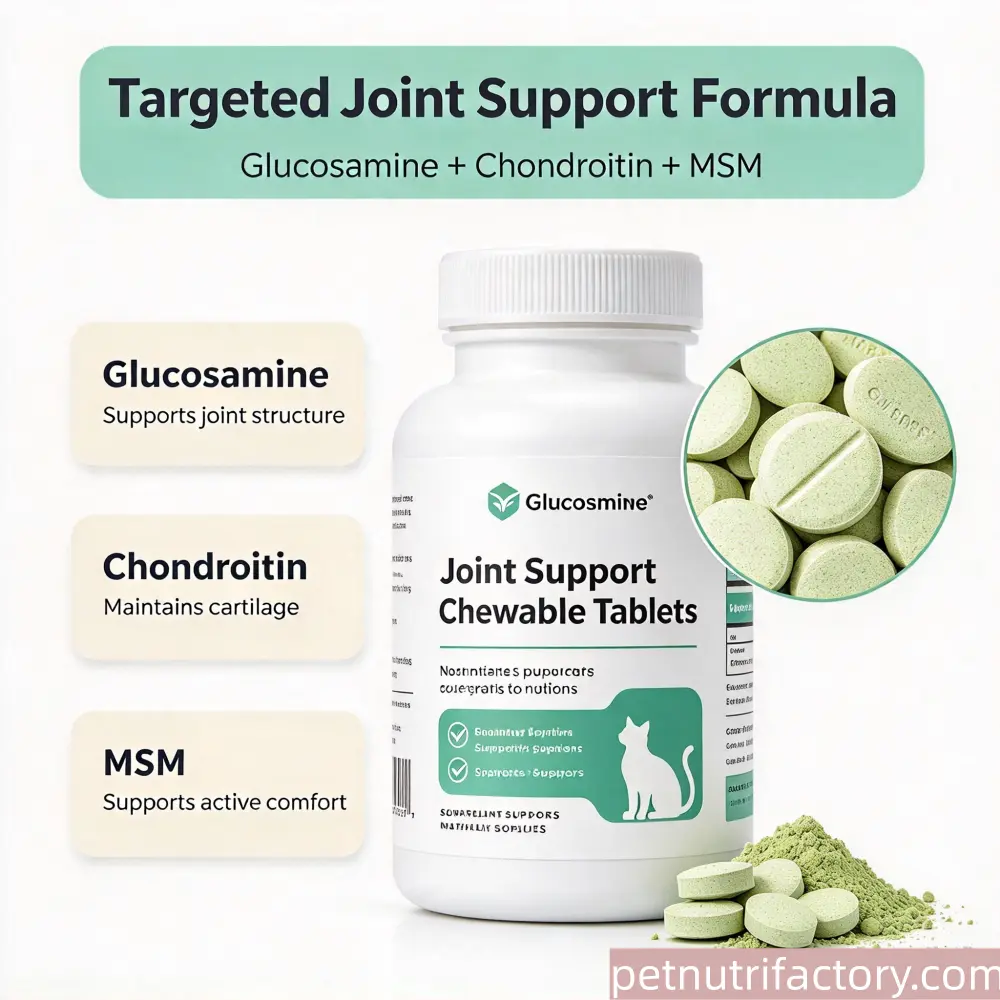
Joint Support Chewable Tablets â OEM & ODM Manufacturing for Pet Joint Health Brands
Chewable tablets occupy a specific position in the pet joint supplement category: they are the format that delivers the highest active load per unit at the lowest unit cost, but they are also the format where palatability failure is most visible and most immediate. A powder that tastes wrong can be masked in food. A tablet that a dog refuses, or chews once and spits out, has failed at the point of consumption. This page describes how PetNutriFactory manufactures joint support chewable tablets under OEM and ODM models, and where the engineering decisions sit that determine whether a tablet works commercially.
The format is not marginal. Chewable and soft chew formats together accounted for approximately 48% of the pet dietary supplement market in 2025, and tablets remain the reference point for cost efficiency and dosing precision in many programs[reference:0]. The global dog and cat hip and joint supplement market was estimated at roughly 53 billion RMB in 2025 with a 6.6% CAGR to 2032, and chewable formats are one of the primary delivery routes inside that growth. The question for a brand is not whether chewable tablets belong in a joint portfolio, but whether the manufacturing partner can hold the three variables that define a chewable tablet â active load, tablet hardness and palatability â without one destroying the other two.
Why Chewable Tablets Are Harder to Manufacture Than They Appear
Joint support chewable tablets are not compressed candy with glucosamine added. The formulation space is constrained by a set of competing requirements that a general-purpose tablet press cannot resolve on its own.
The first constraint is active load. Glucosamine HCl, chondroitin sulfate and MSM are bulky actives. A joint tablet that carries a meaningful dose of all three at a commercially acceptable tablet weight requires a diluent system that compresses well without diluting the active profile below the label claim. The second constraint is chewability. A tablet hard enough to survive packaging, shipping and retail handling is not automatically a tablet a dog will chew. Friability must stay low enough for mechanical integrity while the tablet matrix stays soft enough to be voluntarily consumed. The third constraint is taste. Glucosamine and MSM carry inherent bitterness and sulfur notes; a chewable tablet that does not mask them will be rejected regardless of how well it compresses.
The fourth constraint is regulatory form. AAFCO labeling frameworks permit mineral and vitamin guarantees to be expressed in milligrams per unit â tablets included â consistent with the quantity statement and directions for use[reference:2]. That per-unit structure is an advantage for tablets, because it maps cleanly to a âone tablet per dayâ or âone tablet per 10 kg body weightâ regimen. But it also means the label claim is tied directly to tablet weight and content uniformity, which makes compression control a compliance issue, not only a production issue.
OEM and ODM Scope for Joint Chewable Tablets
We run chewable tablet projects under two distinct engagement models, and the boundary between them is the same one we apply to other supplement formats: formula ownership and development responsibility.
OEM: Manufacturing to Your Locked Formula
In the OEM model, you provide the formula, the target active levels per tablet and the label specification. We review the formula for compressibility, flow and ejection characteristics, flag excipient incompatibilities or process risks, and manufacture against your locked specification. Your formula IP stays with you. We do not reformulate without written approval. This model suits brands that have already developed a tablet and need a manufacturing base with chewable-tablet capability, capacity or a second source qualified.
ODM: Tablet Development from Brief to Bulk
In the ODM model, you provide the commercial brief â species, target daily dose, flavor direction, tablet size expectation, packaging format and destination market. Our development team selects the compression route, the diluent and binder system, the palatability architecture and the tablet geometry, then delivers a production-ready chewable tablet under your brand. You approve the sample; we own the path from brief to bulk. This is the appropriate model for brands adding a joint tablet without an in-house formulation function, or for distributors building a multi-format joint range where the tablet is the cost-anchor SKU.
Compression Route: Direct Compression vs. Granulation
The choice of compression route is the single most consequential manufacturing decision for a joint chewable tablet, because it determines which active loads are feasible, what tablet hardness range is achievable, and how much process development the project requires.
Direct Compression
Direct compression is the simplest and most efficient route for chewable tablets when the formulation supports it. The actives and excipients are blended and compressed without a granulation step, which shortens the process, reduces equipment exposure and lowers cost[reference:3]. For joint tablets with moderate active load and a well-designed diluent system, direct compression is often sufficient. In published chewable-tablet work using glucosamine HCl at 30% load, a diluent combination of partially pregelatinized starch and microcrystalline cellulose at a 1:1 or 1:2 ratio has been shown to produce tablets with good hardness, low friability and fast disintegration under direct compression[reference:4]. That combination is relevant to joint tablets specifically because it gives compressibility without introducing a granulation step that would add heat and moisture exposure to heat-sensitive actives.
Wet Granulation
When active load is higher, or when the active powder blend is too poorly flowing or too low in density for direct compression, wet granulation becomes the appropriate route. The powder is mixed with a granulating liquid to form a granular mass, dried, sized and then compressed[reference:5]. Wet granulation improves flow, reduces segregation of low-dose components and can produce a more uniform tablet at higher active loads. The trade-off is process complexity and cost: additional unit operations, drying time and the need to validate granule properties before compression. For a joint chewable tablet where the formula requires a high glucosamine plus chondroitin plus MSM load in a single tablet of acceptable size, granulation is often the route that makes the label claim achievable.
We assess the route at brief stage rather than defaulting to one method. A direct-compression project that should have been granulated produces tablets that fail friability or content uniformity; a granulation project that could have been direct-compressed adds cost and lead time for no product benefit.
Tablet Quality Attributes: Hardness, Friability, Disintegration and Weight Uniformity
A chewable tablet is defined by a small set of physical attributes, and those attributes are where OEM/ODM manufacturing discipline becomes visible to the buyer.
Hardness must be high enough to survive primary packaging, secondary packaging and distribution without chipping, but low enough that the tablet remains chewable. The target window is narrower than for a swallowable tablet because the end user is a dog or cat, not a human swallowing with water. Friability is measured as weight loss under mechanical tumbling; a chewable tablet with excessive friability will shed material in the jar or pouch, producing an inconsistent dose and an unattractive product. Disintegration time matters for chewable tablets as well, not because the tablet must dissolve in water, but because a tablet that resists breakdown in the mouth is more likely to be chewed once and rejected. Weight uniformity is the compliance attribute: if tablet weight varies, the per-unit label claim varies with it.
Our tablet development work treats these attributes as a linked set rather than independent specifications. Changing the diluent ratio to improve hardness will shift disintegration and mouthfeel; changing the binder level to improve chewability will shift friability. The formulation and process parameters are locked together, and the specification issued with the approved sample is the specification the bulk production run is held to.
Palatability Engineering: Taste Masking, Flavor and the Chewable Matrix
Palatability in a chewable tablet is not a coating decision applied at the end of development. EMA-aligned definitions of palatability for veterinary dosage forms include taste, smell and mouthfeel â texture, size and chewiness â which means the palatability system is distributed across the tablet matrix, not layered on top of it[reference:6]. For a joint chewable tablet, that has three practical implications.
First, taste masking must be designed into the active-containing phase. Glucosamine and MSM cannot simply be flavored over; the bitter and sulfur notes need to be moderated at the particle or granule level, through coating, granulation with masking excipients, or selection of active grades with better sensory profiles. Second, the flavor system must be compatible with the compression route. Liquid flavors added before direct compression can affect flow and sticking; heat-sensitive flavors may not survive granulation drying. The flavor system and the compression route have to be selected together. Third, mouthfeel is a formulation variable. A tablet that is too hard feels like a pill; a tablet that is too soft gums up the press and produces friable product. Starch-based excipients have been used in chewable and soft chew systems specifically because they combine compressibility with a mouthfeel acceptable to companion animals, and because they can absorb oily palatants without compromising tablet integrity[reference:7][reference:8].
We develop the palatability system alongside the compression route, not after it. A tablet that compresses perfectly but is rejected at first chew is a failed development, and rebuilding the matrix after a palatability failure costs more than designing for acceptance from the start.
Per-Unit Labeling and Compliance for Chewable Joint Tablets
Chewable tablets have a labeling structure that is distinct from powders. AAFCO frameworks allow guarantees to be expressed per unit â per tablet â which aligns the label with the feeding directions and gives the consumer a direct dose-to-tablet correspondence[reference:9]. This is an advantage for brand clarity, but it places the content-uniformity burden on manufacturing: if the tablet weight specification drifts, the per-tablet claim drifts with it.
Our compliance support for chewable joint tablets covers guaranteed analysis formatting on a per-tablet basis, ingredient statement review against the formula, and flagging of claim language that may create exposure in the destination market. The regulatory landscape is not uniform across markets: the U.S. operates under AAFCO and FDA frameworks, the EU under FEDIAF, and destination-specific requirements for permitted ingredients and claims vary. We scope testing and declaration requirements at quotation stage so that the label and the documentation package are aligned before production, not reconciled after.
Documentation issued with chewable tablet orders includes a certificate of analysis covering identity, active content, hardness, friability, disintegration and microbiological parameters, batch records traceable to raw material lots, and label content review notes. Where a buyerâs market requires additional testing, that scope is added to the batch protocol rather than handled as an exception.
Packaging, MOQ and the Trial Path for Chewable Tablets
Chewable joint tablets are typically packed in HDPE jars, blister packs or foil pouches. The packaging choice interacts with tablet hardness and friability: a tablet that performs adequately in a jar may chip in a blister line, and a tablet designed for blister protection may be harder than necessary for a jar format. We confirm packaging compatibility at sample stage rather than after the bulk run.
MOQ for chewable tablets is driven by tablet tooling, compression run length and packaging format. A new tablet geometry requires tooling, which sets a practical floor on the first order independent of the bulk powder cost. Trial and sample orders are supported so that palatability, hardness and packaging performance can be validated before a commercial run. We quote MOQ at the specific tablet size and packaging format you intend to sell, because a small chewable tablet in a blister pack and a larger tablet in a jar have different economic minimums even when the formula is identical.
Start a Joint Support Chewable Tablet Project
Send your target species, daily dose expectation, flavor direction, tablet size preference, packaging format and indicative first-order volume. If you have an existing formula, include the active levels per tablet for an OEM feasibility review. We will respond with a compression route recommendation, a palatability development path and a cost-per-tablet estimate.