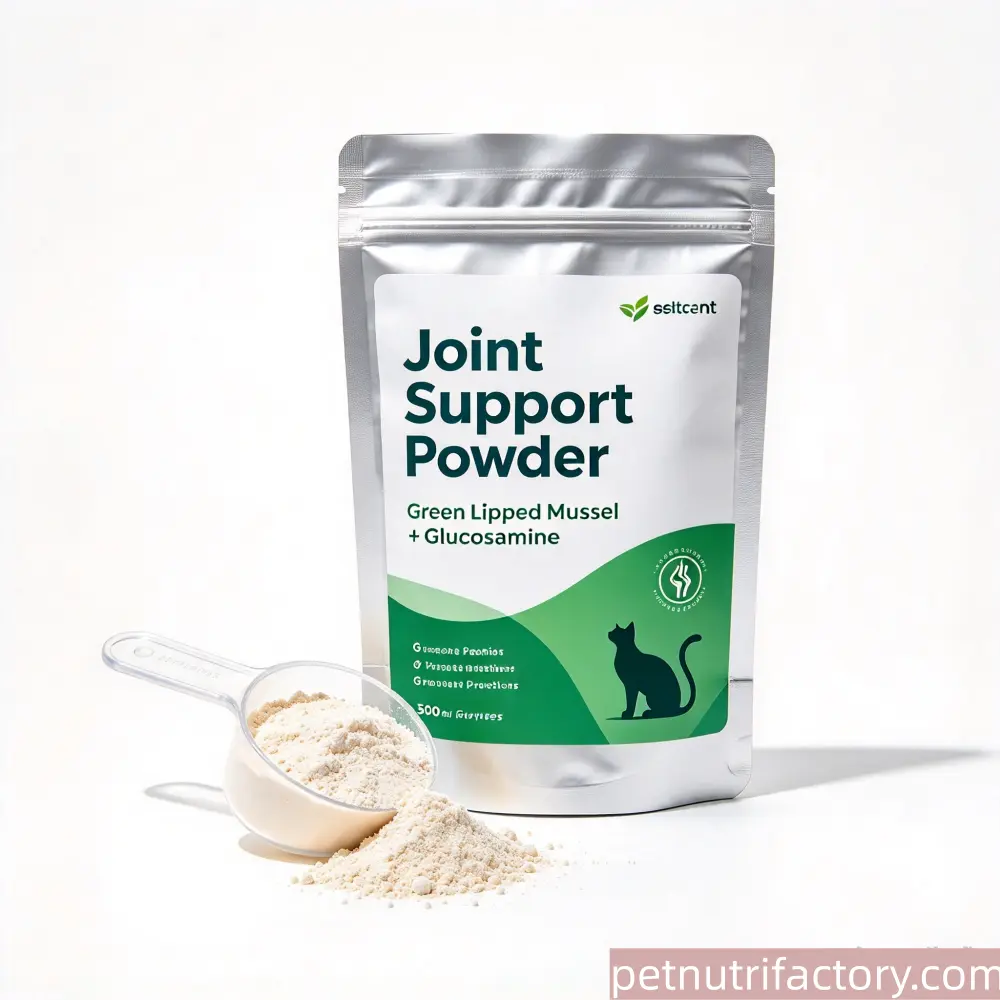
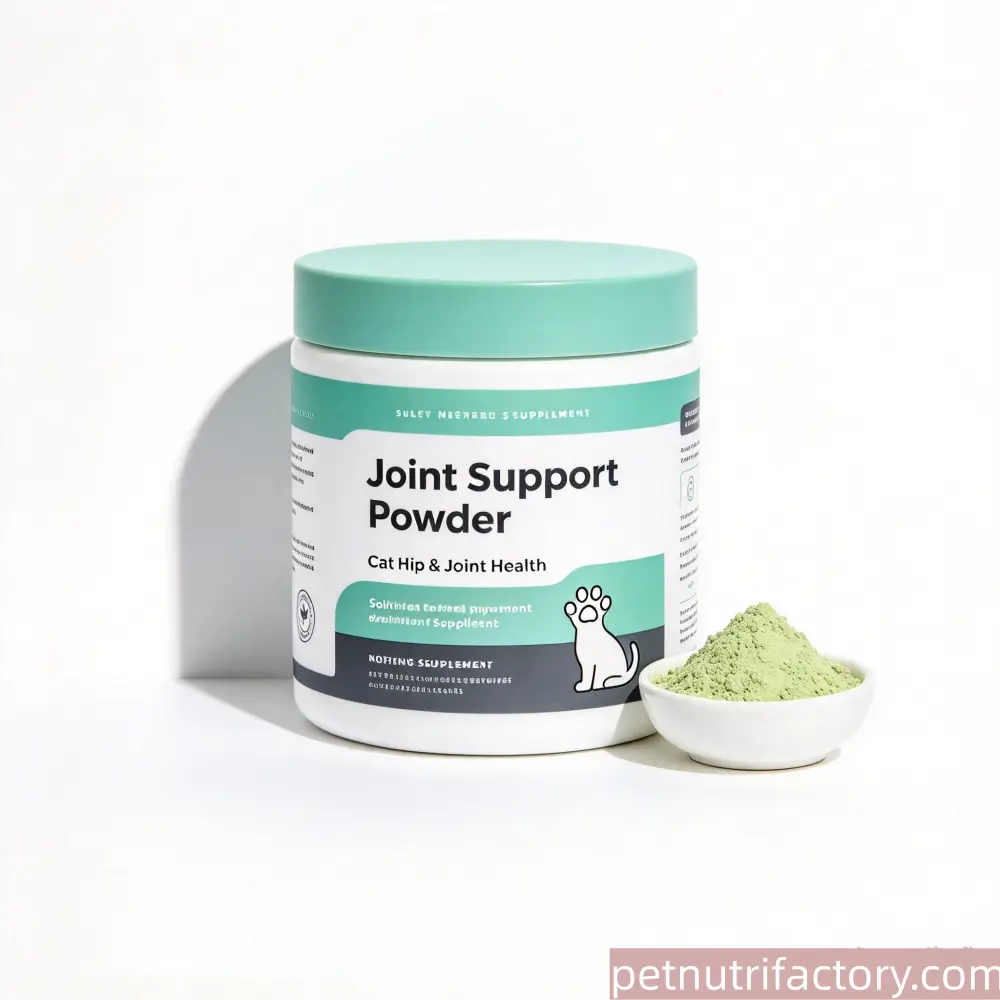
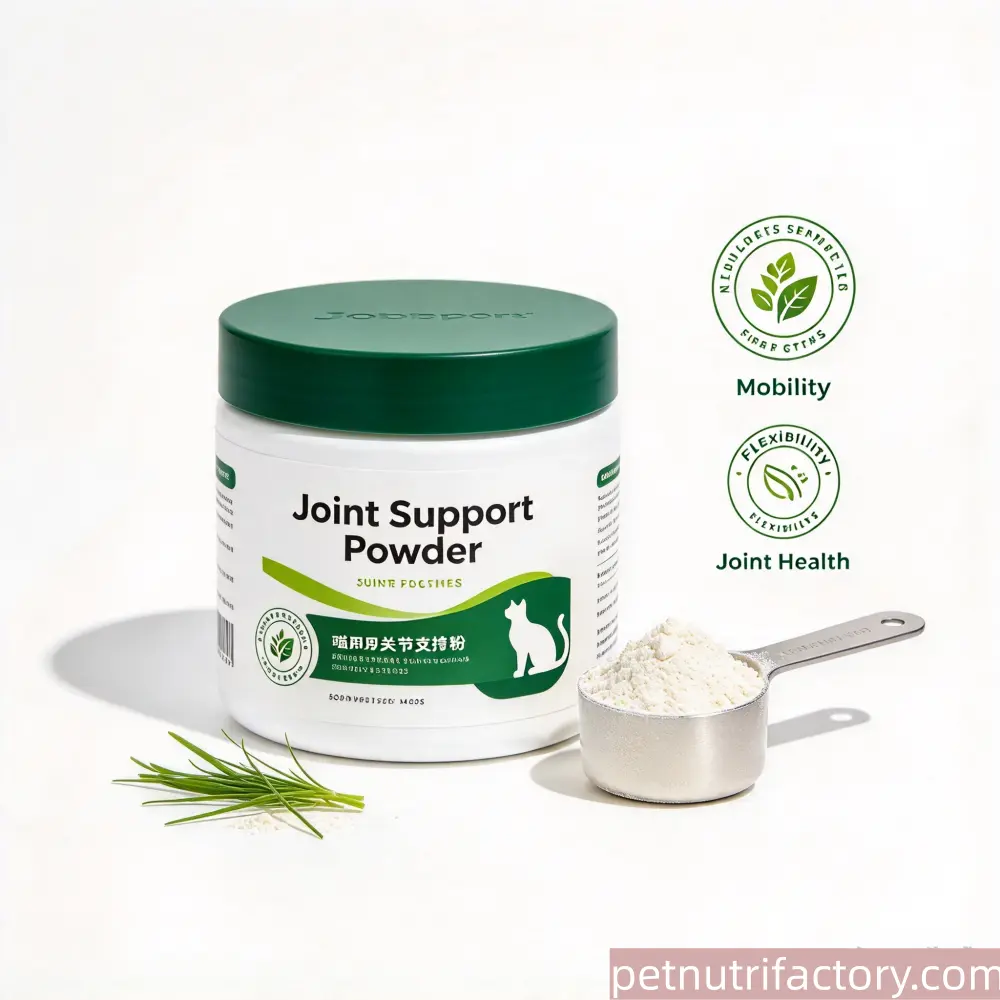
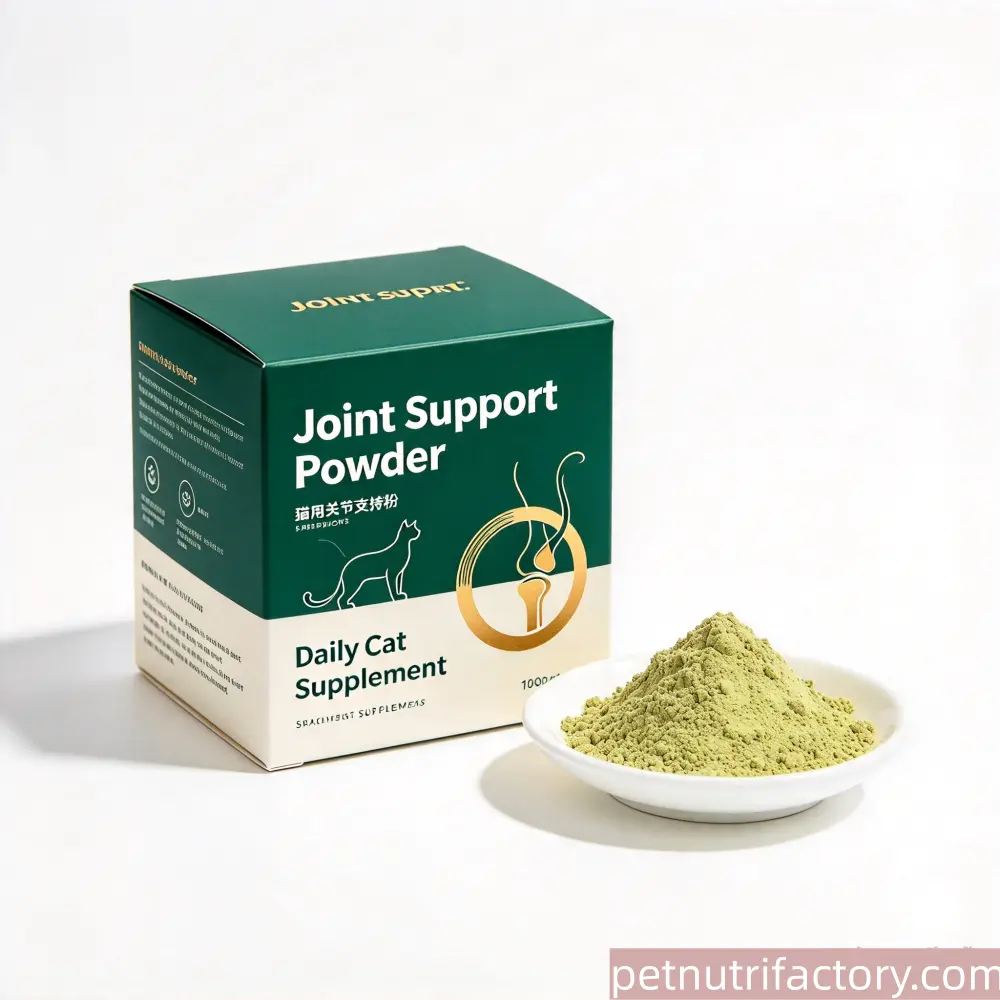
Joint Support Powder
- Model No.: JOINT-3001
- Product Name: Joint Support Powder
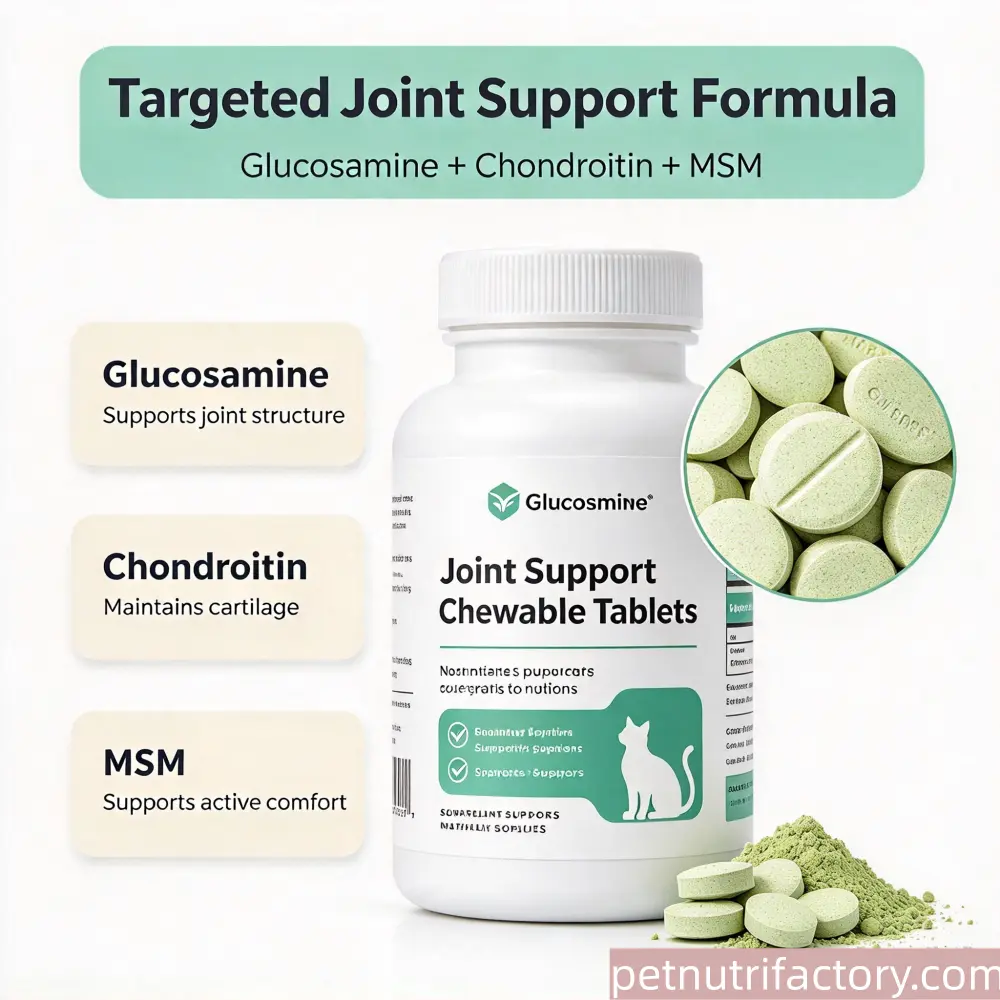
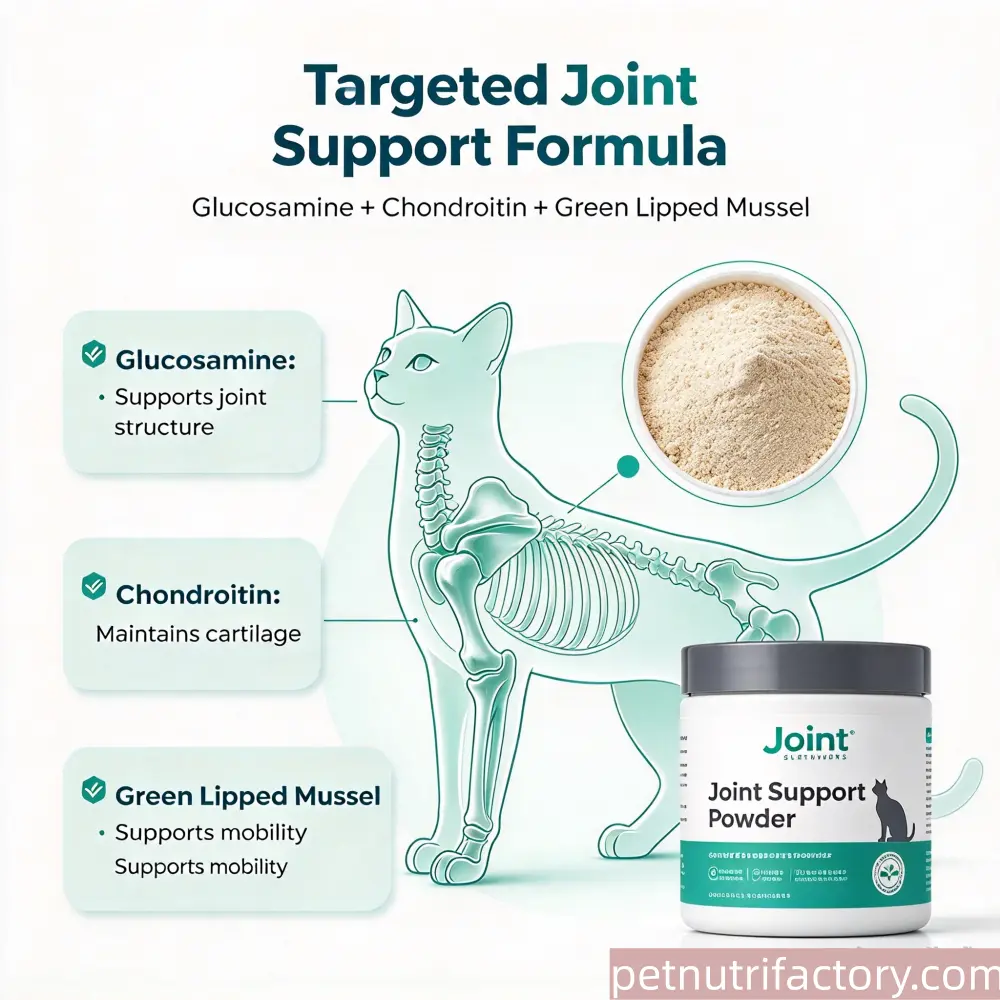
- Contains Glucosamine & Chondroitin to support healthy joint function
- Helps maintain mobility and ease joint discomfort for cats & dogs
- Nourishes cartilage and protects joint cushioning structure
- Ideal for senior pets and active pets with high exercise load
- All-natural formula, free from artificial colors and preservatives
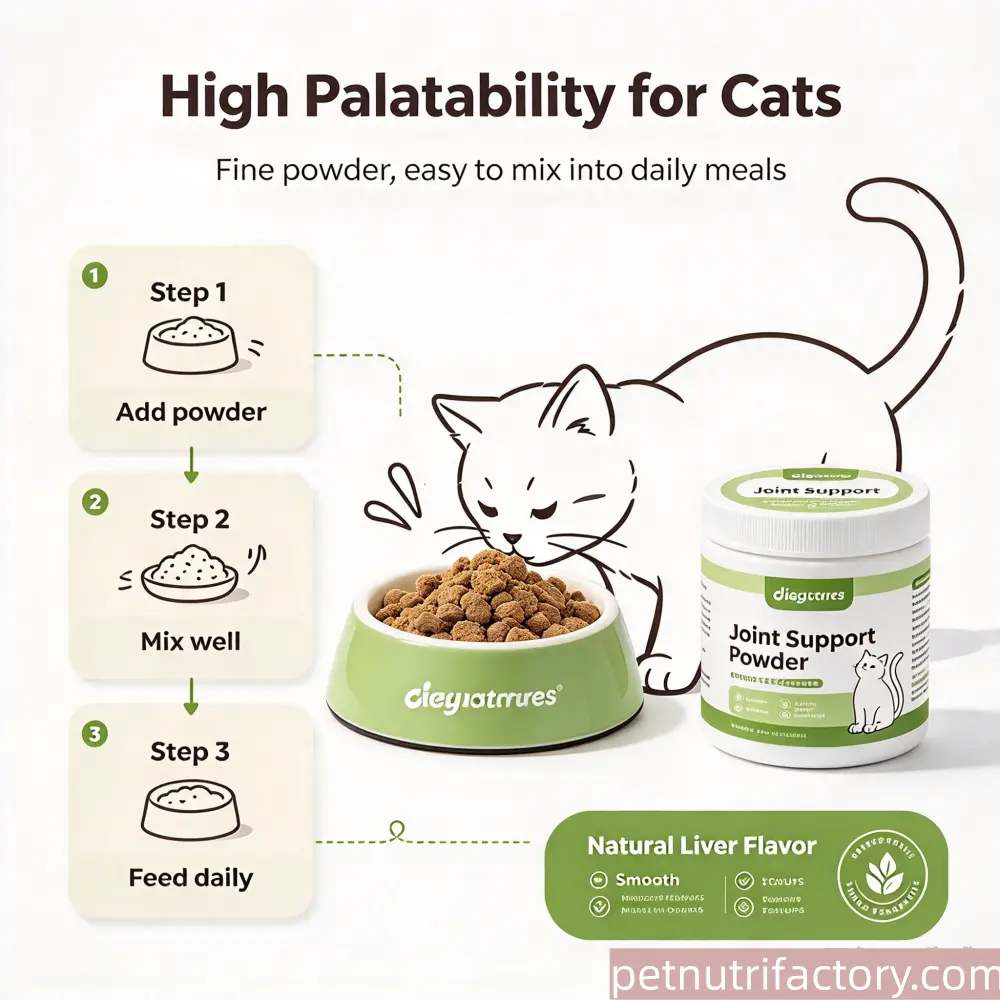
- Fine palatable powder, easy to blend into daily pet meals
Customization Services
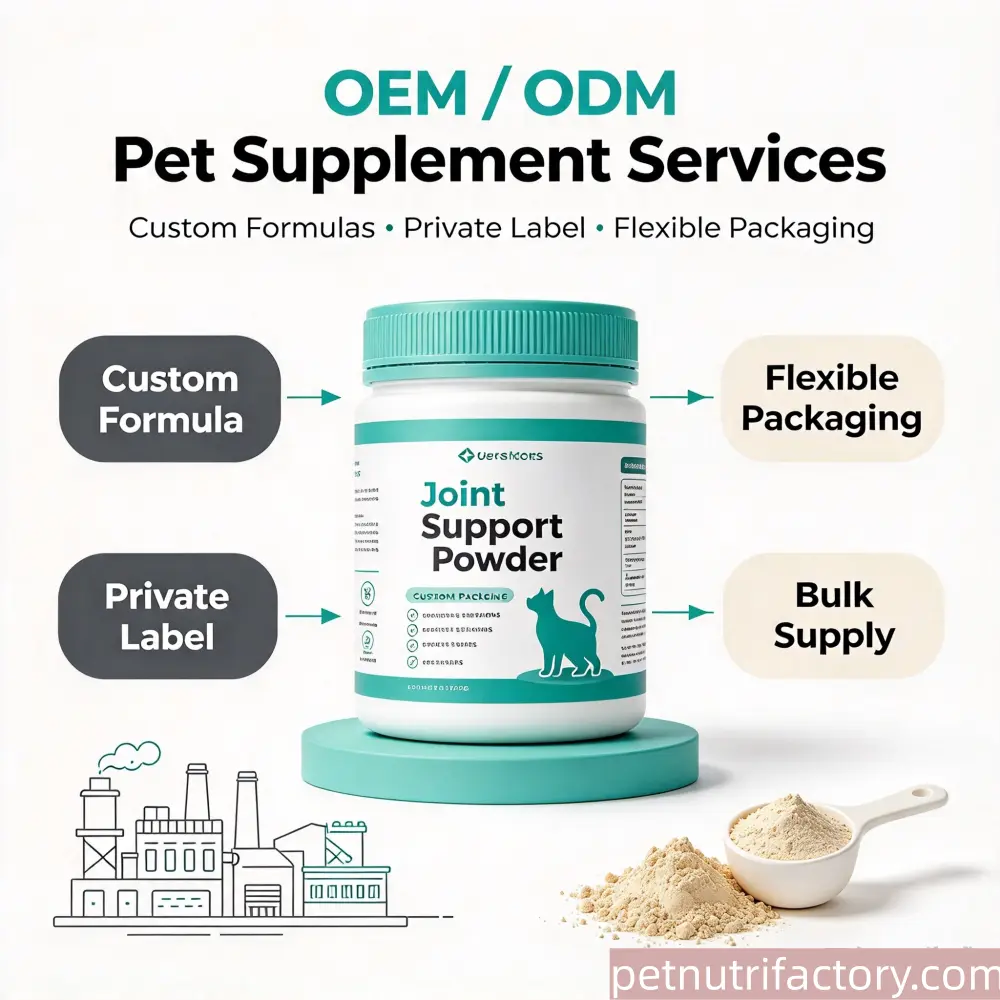
- Custom Formula & Raw Material Selection for diverse pet health and nutritional requirements
- Personalized flavor, color and graphic design to fit your brand positioning
- Custom dosage and potency for targeted pet groups and market levels
- Private label logo printing & custom packaging surface treatment
- Custom product shape, specification and packaging solution to boost brand image
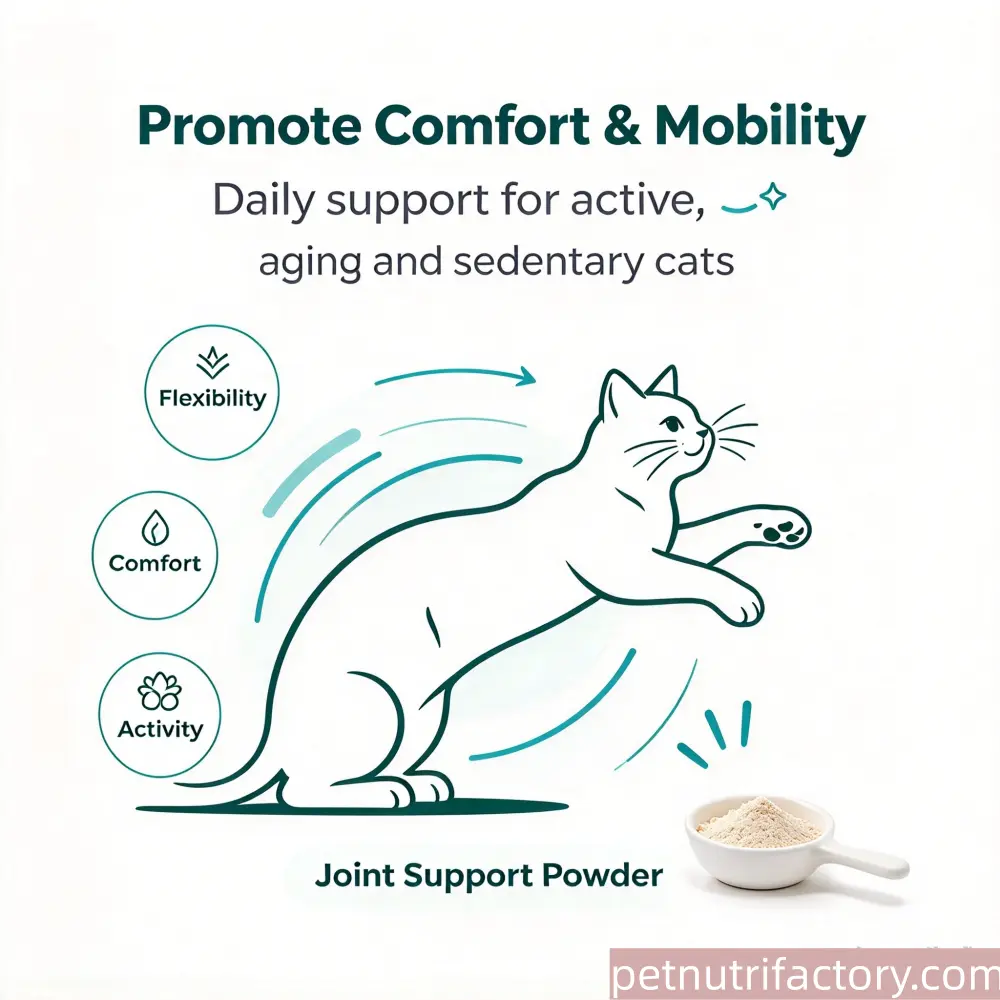
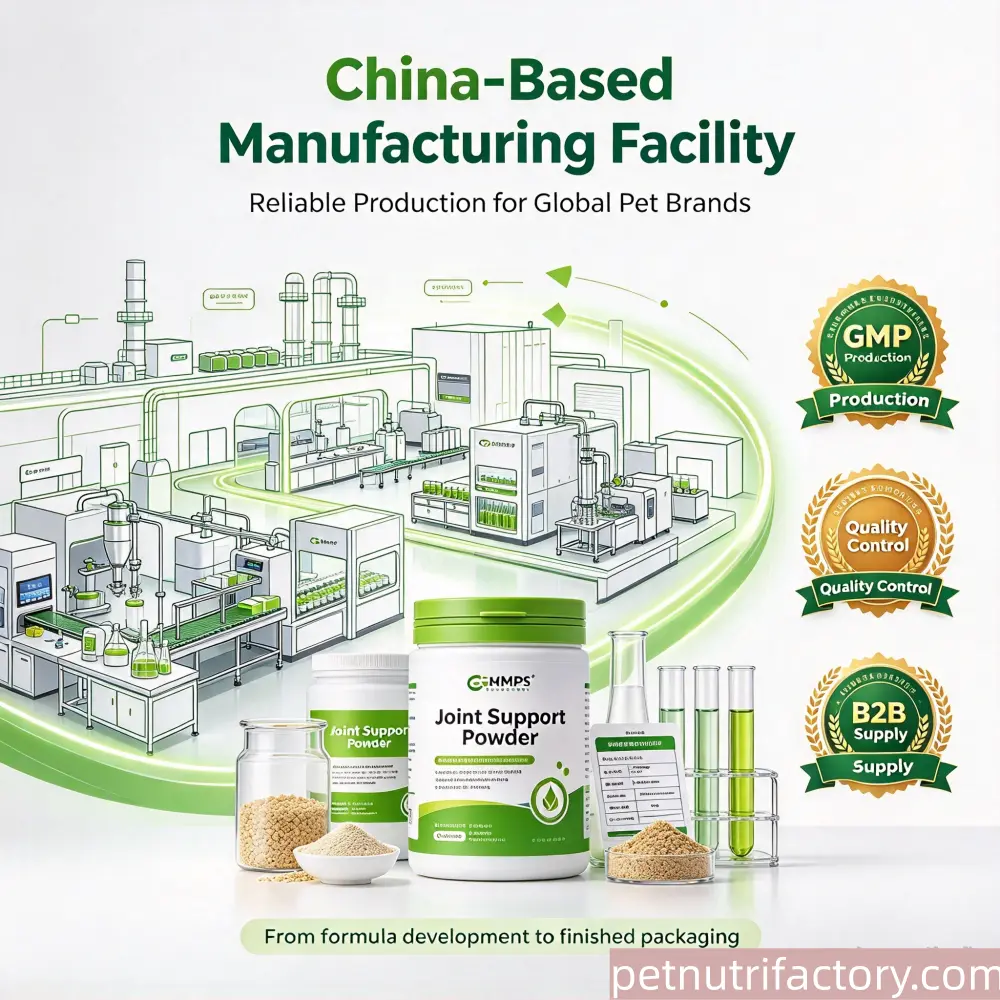
Joint Support Powder for Dogs and Cats
Joint Support Powder is a pet nutritional supplement developed for brands seeking convenient joint health products for dogs and cats. Formulated with glucosamine and chondroitin, this product is designed to support normal joint function, maintain mobility and provide nutritional support for cartilage and connective tissue. Its fine powder format makes it easy to incorporate into daily pet meals, offering a practical solution for pet supplement brands, distributors, wholesalers and importers looking to expand their joint care product portfolios.
Pet Nutri Factory provides a product development and manufacturing platform for businesses interested in pet nutritional supplements. With a focus on product specifications, formulation requirements and commercial packaging, our OEM and ODM approach supports buyers looking to develop products under their own brands. Joint Support Powder, model JOINT-3001, offers a starting point for businesses seeking a joint health supplement with a recognizable ingredient profile and a convenient feeding format.
The proposed formula combines glucosamine and chondroitin, two ingredients commonly used in joint-support nutritional products. The powder format offers flexibility for daily feeding and can be incorporated into a variety of pet nutrition product ranges. Depending on the final formula, ingredient concentrations and feeding instructions, the product may be developed for dogs, cats or specific target segments within the companion animal market.
For B2B buyers, successful product development requires more than selecting a product name and packaging design. Ingredient specifications, formulation stability, palatability, serving size, quality documentation and destination-market requirements should all be considered before commercial production. These factors help establish a consistent product specification and support a more reliable private label manufacturing process.
Product Overview
Product Model: JOINT-3001. Product Name: Joint Support Powder. Product Category: Pet Nutritional Supplements. Target Animals: Dogs and Cats, subject to final formula suitability. Dosage Form: Fine Powder. Key Ingredients: Glucosamine and Chondroitin. Primary Positioning: Joint Health and Mobility Support. Manufacturing Options: OEM, ODM and Private Label, subject to project requirements and manufacturing feasibility.
JOINT-3001 is designed around the nutritional needs of pet brands developing products for joint health and mobility support. Glucosamine and chondroitin form the core of the proposed ingredient profile, while the powder format offers a convenient alternative to tablets, capsules and other dosage forms. This flexibility may be particularly useful for brands serving customers who prefer to mix supplements with regular pet food.
The product concept is suitable for businesses exploring joint nutrition products for senior pets, active animals and general pet wellness markets. However, the appropriate target audience depends on the final ingredient concentrations, recommended serving size and supporting evidence. Product descriptions should focus on nutritional support rather than suggesting that the supplement treats or cures joint disease.
For manufacturers, distributors and importers, a clearly defined product specification helps simplify supplier evaluation and commercial planning. Buyers can assess the proposed ingredients, request samples where available, review quality documentation and discuss packaging options before committing to a production order.
Key Product Features
Glucosamine for Joint Health Support
Glucosamine is a commonly used ingredient in joint-support supplements for companion animals. It is associated with the formation and maintenance of cartilage and other connective tissues. In pet nutrition products, glucosamine is used as part of a nutritional approach to supporting normal joint function and mobility.
For JOINT-3001, glucosamine provides a recognizable ingredient that can help establish the product's position within the pet joint supplement category. Its inclusion may appeal to brands seeking to develop a straightforward joint health formula for dogs and cats. The final nutritional contribution depends on the source of glucosamine, its concentration, the overall formulation and the recommended daily serving.
B2B buyers should confirm the exact glucosamine specification before approving the product. Important considerations include ingredient source, concentration per serving, quality documentation and compatibility with the intended formulation. These details help buyers compare products from different suppliers and determine whether the proposed formula meets their technical and commercial requirements.
When developing a private label product, the glucosamine concentration should be considered alongside the total daily serving and the intended target animals. A powder product may offer flexibility in serving size, but the final instructions must remain clear, practical and appropriate for the approved formula.
Chondroitin for Cartilage and Joint Support
Chondroitin is frequently used alongside glucosamine in nutritional products designed to support joint health. It is associated with cartilage structure and is commonly included in formulations intended to provide nutritional support for normal joint function.
The inclusion of chondroitin complements the ingredient profile of JOINT-3001 and provides a familiar combination for brands developing pet joint supplements. This combination can help simplify product positioning for distributors and retailers while allowing the brand owner to communicate the intended nutritional purpose of the formula.
Buyers should review the source, specification and amount of chondroitin in the finished product. The concentration per serving is particularly important when comparing alternative formulas or determining the product's suitability for a specific market segment. Ingredient information should be supported by appropriate supplier documentation and verified against the approved formulation.
Claims concerning cartilage nourishment, joint cushioning or the reduction of joint discomfort should be evaluated carefully. The presence of glucosamine and chondroitin alone does not establish that a finished product will deliver a particular clinical outcome. Marketing claims should be consistent with the available evidence and the regulatory requirements of the intended market.
Joint Support Powder for Senior Pets
Senior pets may experience changes in their movement patterns and activity levels as they age. As a result, joint health is an important consideration in the development of nutritional products for mature dogs and cats. A joint-support supplement may form part of a broader nutritional care routine intended to help maintain normal mobility and general wellbeing.
JOINT-3001 can be considered as a product concept for brands targeting the senior pet nutrition segment. Its glucosamine and chondroitin profile provides a foundation for a joint health positioning, while the powder format allows the supplement to be incorporated into regular meals. This can offer a practical feeding option for pet owners who prefer not to administer tablets.
For B2B buyers, senior pet positioning should be supported by an appropriate formula and clear product instructions. The intended species, serving size, ingredient concentrations and any relevant nutritional limitations should be reviewed before the product is marketed for older animals. Where specific age-related claims are planned, the buyer should confirm that these claims are adequately supported and permitted in the target market.
Brands can also consider packaging and product information that make daily use straightforward. Clear serving instructions, storage guidance and accurate ingredient declarations help customers understand how the product should be used as part of a balanced feeding routine.
Joint Nutrition for Active Dogs and Cats
Active pets may have different nutritional needs from animals with lower activity levels. Dogs that regularly run, hike, train or participate in sporting activities may place substantial demands on their musculoskeletal systems. Some cats also maintain high activity levels through climbing, jumping and play. Appropriate nutrition is one consideration in supporting normal body function in these animals.
JOINT-3001 offers a potential product concept for brands targeting active pets and general mobility support. Glucosamine and chondroitin are commonly used in joint-support formulations, while the powder format makes it possible to incorporate the product into a regular feeding routine. The final formula and serving instructions should be developed according to the intended target animals and product requirements.
For commercial buyers, the active pet segment may require a different marketing approach from the senior pet segment. Product communication can focus on supporting normal joint function and maintaining mobility without making unsupported claims about preventing injuries, accelerating recovery or improving athletic performance.
Any claims relating to exercise load, physical performance or specific joint outcomes should be reviewed against appropriate evidence. A nutritional supplement should not be presented as a substitute for veterinary assessment, appropriate exercise management or a complete and balanced diet.
Fine Powder Format for Convenient Feeding
The fine powder format is a central feature of JOINT-3001. Compared with tablets or capsules, powder supplements can offer greater flexibility when incorporating ingredients into daily pet meals. This format may be particularly attractive to pet brands that want to offer an alternative for customers who prefer to mix supplements with dry or wet food.
Powder formulation requires careful attention to particle size, flow characteristics, ingredient distribution and product handling. A consistent powder helps support accurate packaging and serving instructions. The final product should also be assessed for its ability to blend with the intended food formats without creating unnecessary handling difficulties.
Palatability is another important consideration. The taste and smell of a finished supplement can influence acceptance by dogs and cats, and preferences may vary between individual animals. Ingredient selection and any flavoring system should therefore be evaluated in relation to the intended species and the overall formula.
For OEM and ODM buyers, the powder format can offer flexibility during product development. Depending on manufacturing capabilities, buyers may discuss serving size, particle characteristics, flavor profile and packaging format. Any requested adjustments should be assessed for compatibility, stability, production feasibility and cost before the final specification is approved.
Packaging should protect the powder from conditions that could compromise its quality. Moisture exposure, container compatibility, closure performance and storage conditions should be evaluated according to the final formulation. A suitable packaging system can help maintain product quality during storage, transport and distribution.
Product Specifications
The following table outlines the proposed product information for JOINT-3001. Quantitative specifications, including ingredient concentrations, serving size and shelf life, should be confirmed against the approved formula and relevant manufacturing documentation.
| Specification | Product Information |
|---|---|
| Model Number | JOINT-3001 |
| Product Name | Joint Support Powder |
| Product Category | Pet Nutritional Supplements |
| Target Animals | Dogs and Cats, subject to formula suitability |
| Dosage Form | Fine Powder |
| Key Ingredients | Glucosamine and Chondroitin |
| Primary Product Positioning | Joint Health and Mobility Support |
| Intended Feeding Method | Mixed with pet food according to approved instructions |
| Artificial Colors | Excluded according to the stated product specification |
| Artificial Preservatives | Excluded according to the stated product specification |
| Ingredient Concentrations | To be confirmed against the approved formula |
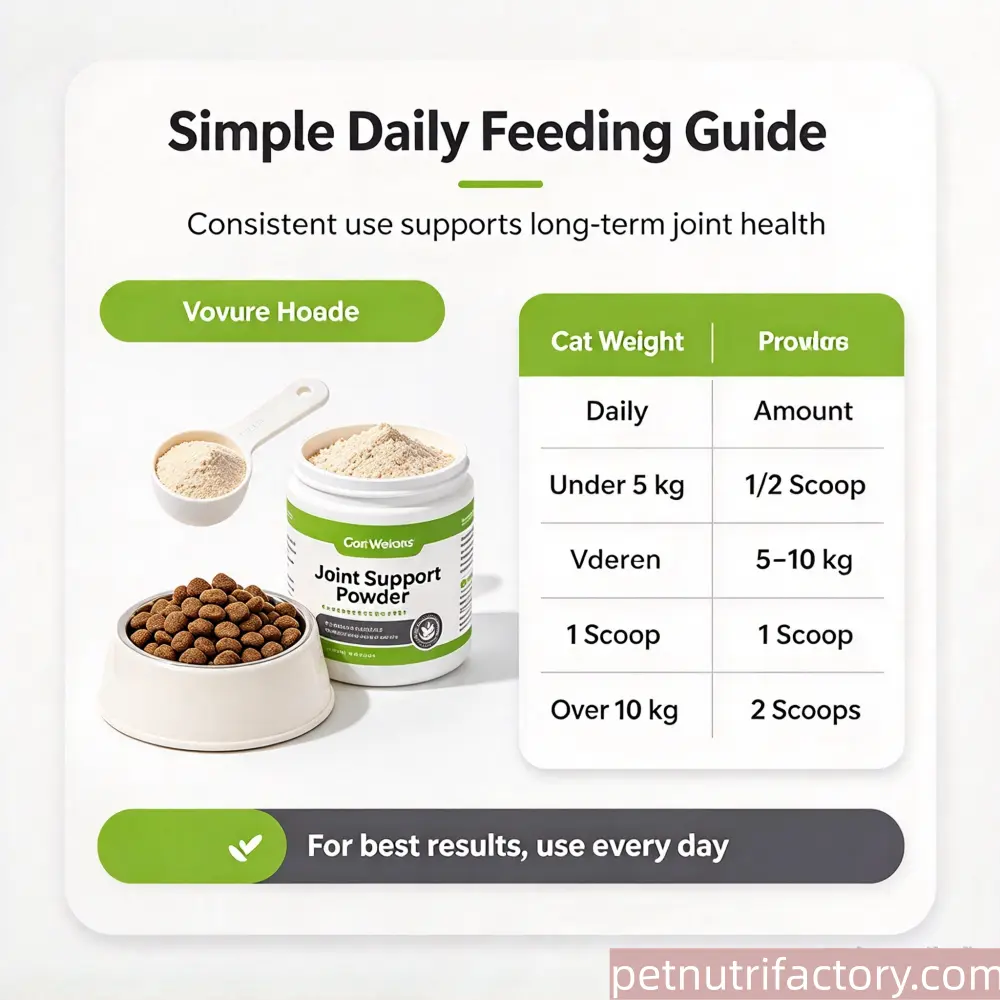
| Serving Size | To be established according to the final formula and target species |
| Flavor Profile | To be confirmed |
| Net Weight | To be confirmed |
| Shelf Life | To be confirmed through appropriate stability assessment |
| Packaging | Subject to buyer requirements and packaging availability |
| Manufacturing Options | OEM, ODM and Private Label, subject to confirmation |
Ingredient Quality and Formula Development
Ingredient quality is an essential consideration when developing pet nutritional supplements. For JOINT-3001, the specifications of glucosamine and chondroitin should be established before the final formula is approved. Ingredient source, identity, concentration, purity and relevant quality documentation can all influence the suitability of a product for a particular market.
For B2B buyers, ingredient documentation provides a foundation for evaluating suppliers and managing product quality. Depending on the ingredient and project requirements, relevant documents may include ingredient specifications, certificates of analysis and other quality records. Buyers should confirm the availability and scope of these documents rather than assuming that all suppliers provide identical documentation.
Ingredient selection should also take account of the physical properties of the finished powder. Different ingredients may vary in particle size, density, flow behavior and moisture sensitivity. These factors can affect blending, packaging and serving consistency. Appropriate formulation and process controls are therefore important when developing a product intended for repeated commercial production.
Formula development should balance ingredient concentrations, powder characteristics, palatability, stability and cost. Adding more ingredients or increasing their concentrations may change the product's physical properties and commercial price. Each adjustment should be evaluated against the intended product specification rather than treated as an isolated change.
For private label projects, an approved formula should be documented clearly. The record should identify the agreed ingredients and relevant specifications, together with the process for reviewing any proposed changes. This approach helps buyers maintain consistency across repeat orders and provides a clear reference for quality checks.
Manufacturing Quality Control
Reliable pet supplement manufacturing depends on defined specifications and appropriate quality controls. For a powder product such as JOINT-3001, relevant considerations may include ingredient verification, blending consistency, powder appearance, moisture-related parameters, packaging integrity and finished-product testing where applicable.
The exact quality control plan should be established according to the formula, manufacturing process, applicable regulations and buyer requirements. Not every product requires the same tests, and the specific checks performed should be confirmed with the manufacturer. Buyers should request documentation describing the relevant procedures and available test results before finalizing a commercial order.
Blending consistency is particularly important for multi-ingredient powders. The manufacturing process should be designed to achieve an appropriate distribution of ingredients throughout the finished product. Process controls and suitable testing can help verify that the product meets its approved specification.
Moisture management is another important consideration. Excessive moisture exposure may affect powder flow, physical properties or product stability, depending on the formulation. Packaging materials, storage conditions and closure systems should therefore be selected based on the finished product's requirements.
Finished-product quality should be assessed against documented acceptance criteria. These may cover appearance, net weight, packaging condition and other relevant characteristics. Where the buyer requires additional testing, the scope, methods, costs and timing should be agreed before production or shipment.
For international buyers, quality documentation should be reviewed together with destination-market requirements. Product specifications, ingredient records, labeling information and any necessary test reports should correspond to the actual product being supplied. Clear documentation supports supplier evaluation and helps businesses manage their own quality assurance responsibilities.
OEM Joint Support Powder Manufacturing
OEM manufacturing allows pet supplement brands to market products under their own brand names using an agreed product specification. For JOINT-3001, an OEM project may involve confirming the glucosamine and chondroitin formula, selecting the powder characteristics, establishing serving instructions and choosing suitable packaging.
Pet Nutri Factory's B2B product offering is intended for businesses looking to develop pet nutritional products for commercial distribution. Buyers can begin by outlining their target market, expected order quantity, preferred ingredient profile and packaging requirements. These details help establish whether the proposed product specification is suitable for the intended project.
For a private label joint supplement, the buyer should confirm whether an existing formula meets its requirements or whether adjustments are needed. Any changes to ingredient concentrations, flavor profile or powder characteristics should be assessed for technical feasibility, stability, regulatory compliance and cost.
Packaging and branding requirements should also be defined early. Buyers may need custom labels, printed pouches, jars, tubs or cartons, depending on the product and market. The availability, minimum quantities and lead times for these components should be confirmed before production planning is finalized.
OEM manufacturing can be particularly useful for established pet brands, wholesalers and distributors seeking to expand their joint health product ranges. A clear product specification and documented approval process help align the buyer's expectations with the manufacturer's production requirements.
ODM Pet Supplement Product Development
ODM services may be appropriate for businesses that require a more customized product concept. Rather than selecting a standard specification, buyers may want to discuss ingredient combinations, target animal segments, powder characteristics, packaging and overall product positioning. The availability of customization depends on the manufacturer's capabilities and the specific project requirements.
For JOINT-3001, potential development discussions may include the relative concentrations of glucosamine and chondroitin, the intended serving format and the preferred flavor profile. Buyers should explain whether the product is intended for general joint health support, senior pet nutrition or active pet wellness. These distinctions can influence formulation decisions and product communication.
Product customization should be guided by technical requirements and appropriate evidence. Changes to the formula can affect taste, texture, stability, ingredient compatibility and cost. A proposed modification should therefore be evaluated as part of the complete formulation rather than considered solely in terms of marketing appeal.
Before commercial production, the buyer should approve the final formula, product specifications, serving instructions and packaging artwork. Where the product will be sold in multiple countries, destination-market requirements should be considered during development. Ingredient permissions, labeling rules and the classification of pet nutritional products may vary between jurisdictions.
A structured ODM process can help clarify the project scope. Depending on the requirements, the process may include an initial product brief, specification review, formula assessment, sample evaluation and final approval. Development fees, testing costs, minimum quantities and production timelines should be confirmed for each project.
Private Label Packaging Options
Packaging is an important part of the commercial presentation of a pet supplement. For a fine powder product, the selected container should be suitable for the formula and practical for storage, handling and daily use. Potential formats may include jars, tubs, resealable pouches or other appropriate packaging options, subject to supplier availability and product compatibility.
Buyers should consider the relationship between packaging size, net weight, serving instructions and expected product usage. A package should provide sufficient space for the required ingredient declaration, feeding directions, storage information, batch identification and other applicable label details.
Private label development may involve custom artwork, printed packaging materials, branded labels and retail cartons. Buyers should provide their brand guidelines and intended market information before artwork is finalized. This allows the packaging to be reviewed for consistency with the approved formula and applicable labeling requirements.
For powder products, moisture protection and closure performance deserve particular attention. Packaging should be selected according to the product's stability characteristics and expected distribution conditions. Any specific barrier or sealing requirements should be confirmed during technical review.
Packaging minimum order quantities may differ from the minimum quantity required for the supplement itself. Printed materials and customized containers can involve separate setup fees, production lead times or minimum quantities. Buyers should request a detailed quotation that separates product costs from packaging and customization costs where applicable.
Product Applications and Target Markets
Pet Supplement Brands
Established pet supplement brands may consider JOINT-3001 as an addition to their joint health product range. Its glucosamine and chondroitin profile offers a familiar foundation for a joint-support formula, while the powder format provides an alternative to tablets and capsules. Brands can evaluate the final specification against their existing product portfolio and target customers.
Wholesale and Distribution Businesses
Wholesalers and distributors often require products with clearly defined specifications, stable packaging and predictable supply arrangements. A powder supplement may fit into existing pet nutrition distribution channels when the packaging format, storage requirements and commercial terms meet the buyer's needs. Buyers should confirm order quantities, case configurations, lead times and shipping arrangements before placing an order.
International Importers
Importers need reliable product information before introducing a supplement into a new market. Key considerations include ingredient specifications, product labeling, shelf life, packaging details and applicable import requirements. Buyers should work with the supplier and appropriate regulatory advisers to determine what documentation is required in the destination country.
Online Pet Product Businesses
Online retailers and e-commerce brands may look for products that can be presented clearly across digital catalogs and sales platforms. A defined ingredient profile and convenient powder format can support straightforward product descriptions. All commercial claims should accurately reflect the approved formula and avoid unsupported statements about treatment, guaranteed outcomes or disease prevention.
How to Evaluate a Joint Support Powder Supplier
Selecting a manufacturing partner requires a review of technical capability, quality documentation and commercial reliability. Buyers should compare suppliers using consistent criteria rather than relying exclusively on unit price or promotional descriptions.
The first step is to request a detailed product specification. This should identify the ingredient sources, concentrations, powder format, recommended serving instructions, packaging configuration and other relevant product characteristics. Clear specifications help buyers determine whether the product meets their target-market requirements.
The second step is to review the available quality documentation. Buyers should confirm which ingredient records, certificates of analysis and finished-product test reports are available. The scope and relevance of each document should be checked, and any additional testing requirements should be agreed in advance.
Sample evaluation can help buyers assess the powder's appearance, smell, flow characteristics, handling and compatibility with the intended feeding method. If palatability is a major product requirement, a suitable evaluation process should be established. Sample approval should also confirm whether the evaluated sample represents the intended commercial formula.
Commercial terms should be clarified before an order is confirmed. Important details include sample pricing, minimum order quantity, unit price, packaging costs, production lead time, payment terms, shipping arrangements and the process for managing repeat orders.
Buyers should also establish how formula and specification changes will be controlled. Any change to ingredient sources, concentrations, processing methods or packaging should be reviewed according to the agreed quality procedures. This is particularly important for private label products where consistency across batches is essential to the brand owner.
Sample Evaluation and Product Approval
Sample evaluation provides an opportunity to review a product before committing to commercial production. For JOINT-3001, buyers should first establish whether the sample uses the same ingredients, concentrations and processing specifications planned for the final product. Any differences should be documented before the sample is used as a basis for approval.
Evaluation criteria may include powder appearance, color, odor, particle characteristics, flow behavior, packaging compatibility and ease of measuring the recommended serving. Where the product is intended for both dogs and cats, the suitability of the formula and feeding instructions for each species should be reviewed.
Additional laboratory testing may be appropriate depending on the buyer's quality standards and destination-market requirements. The scope of testing should be defined before samples are submitted. Buyers should confirm the test methods, laboratory arrangements, costs and expected turnaround time with the relevant supplier or testing provider.
Once a sample has been approved, the buyer and manufacturer should document the accepted specification. This should include the agreed formula, relevant product characteristics, packaging configuration and approved artwork. Clear records help establish a reference point for production inspections and future orders.
For ongoing supply, the parties should also agree how nonconforming products, complaints and specification changes will be handled. A defined procedure supports more consistent communication and helps businesses manage product quality throughout the commercial relationship.
Storage, Shelf Life and Product Handling
Proper storage is important for maintaining the quality of a powdered pet supplement. The finished product should be stored according to its approved storage instructions, taking account of the formula, packaging and stability characteristics. Buyers should not assume that all powder supplements have identical storage requirements or shelf lives.
Moisture exposure may affect the flow properties and physical characteristics of some powder formulations. Packaging selection should therefore consider container compatibility, closure performance and the expected storage environment. If the product will be transported over long distances, the buyer should also consider the conditions likely to occur throughout the supply chain.
Shelf life should be established using appropriate stability information for the finished product and its packaging. The expiry or best-before information, batch identification and storage instructions should be confirmed before labels are printed and commercial inventory is distributed.
For distributors and wholesalers, stock rotation and inventory management help ensure that products are handled according to their intended shelf life. Products should be stored in accordance with the label instructions, and any damaged packaging or suspected quality issues should be assessed under the buyer's quality procedures.
Develop Your Private Label Joint Support Powder
JOINT-3001 Joint Support Powder provides a starting point for businesses seeking a pet nutritional supplement formulated with glucosamine and chondroitin. Its fine powder format offers a convenient way to incorporate the product into daily pet meals, subject to the final formulation and approved feeding instructions.
Pet supplement brands, wholesalers, distributors and importers can begin by defining their target animals, ingredient requirements, preferred packaging and expected order quantities. These details help establish a practical product brief and identify the technical information required for supplier evaluation.
For OEM and ODM projects, buyers should prepare their product specifications, branding requirements, destination markets and quality documentation needs. Where additional testing or customized formulation is required, the scope, costs and timelines should be agreed before the project moves into commercial production.
A clear product specification helps align formulation, manufacturing, packaging and market preparation. Before placing a bulk order, buyers should confirm the final formula, ingredient concentrations, feeding instructions, product claims and available quality documentation.
Contact Pet Nutri Factory to discuss JOINT-3001 Joint Support Powder and explore suitable OEM, ODM and private label manufacturing options for your pet supplement business.
Other product you may like
The Most Popular Custom Pet Nutritional Supplements from a Leading Chinese Manufacturer