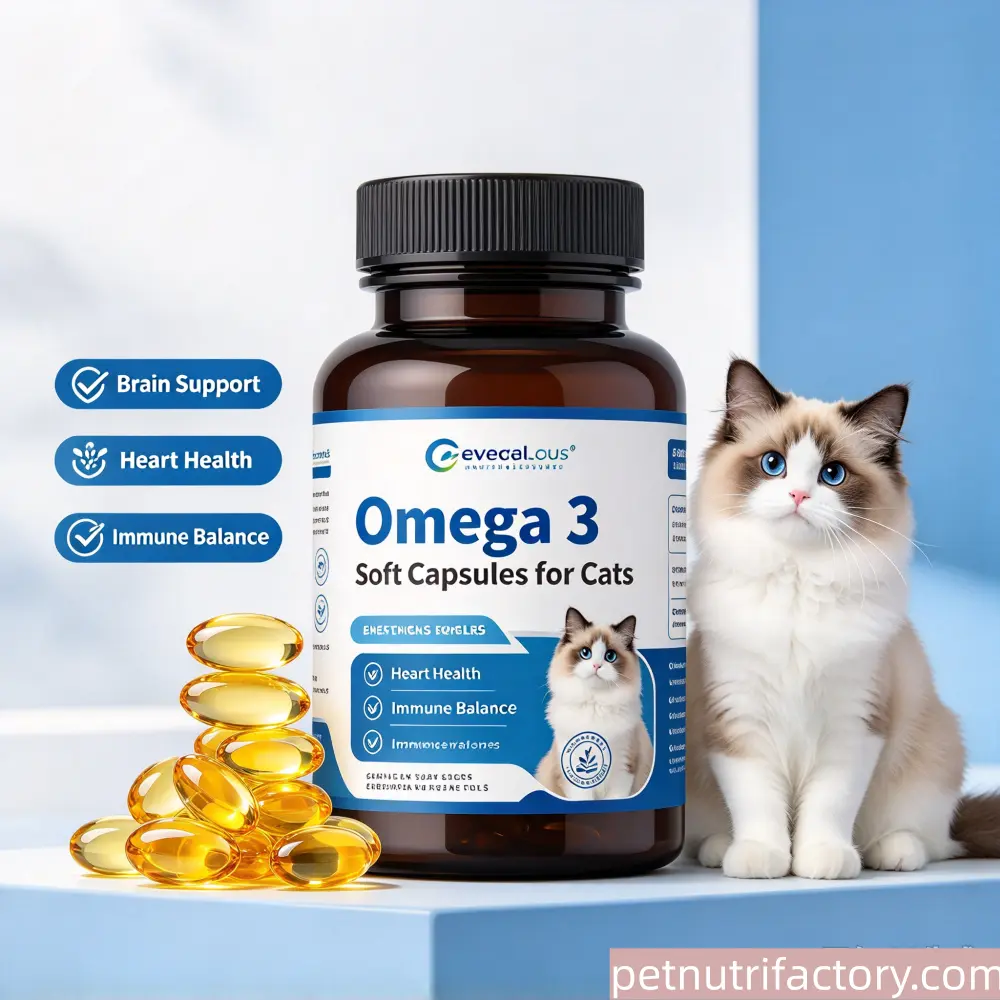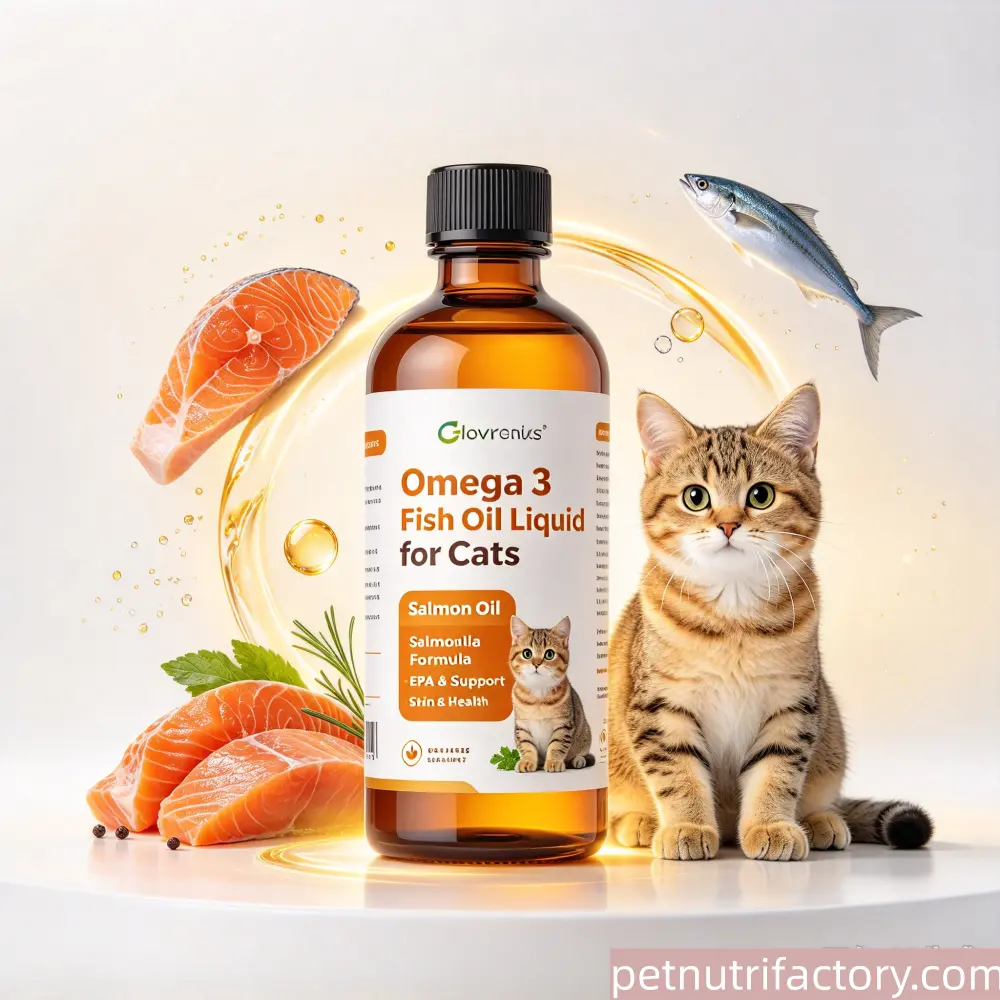
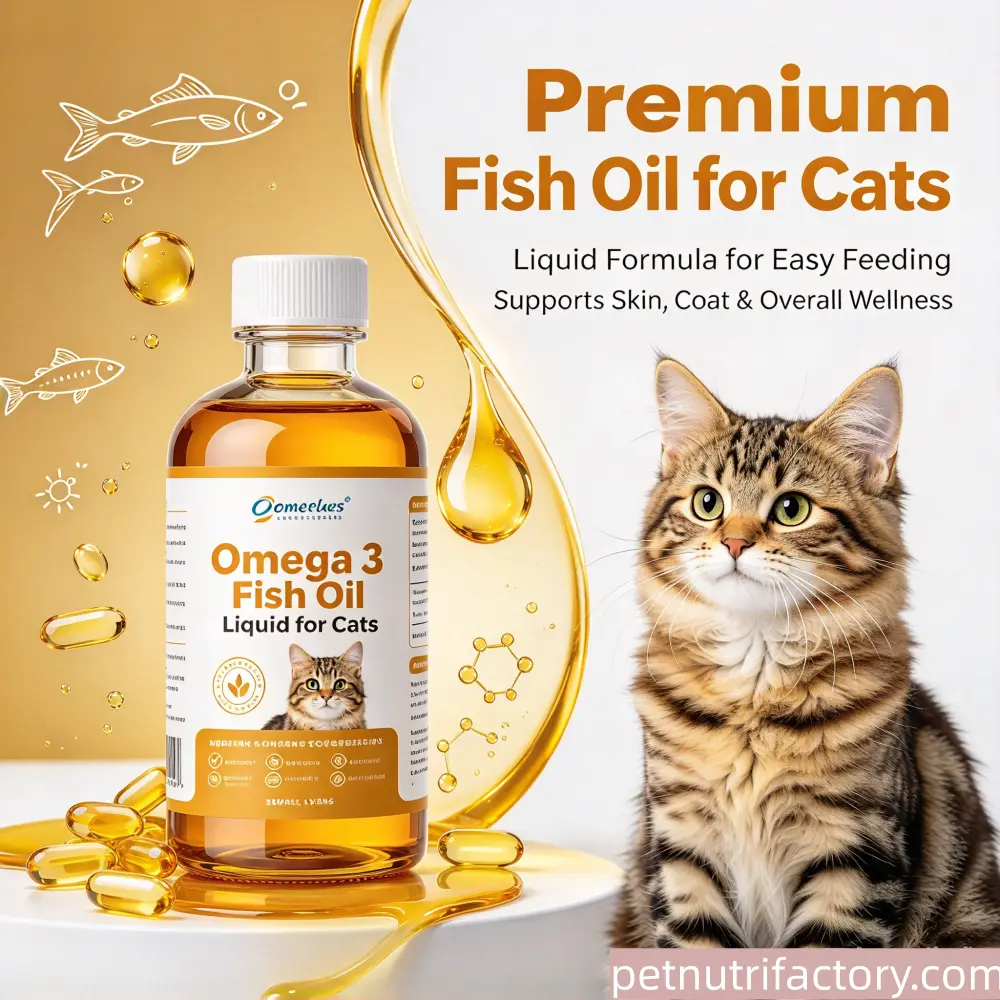
Omega 3 Fish Oil Liquid for Cats
- Model No.: SKIN-1004
- Product Name: Omega 3 Fish Oil Liquid for Cats
- Formulated with natural sunflower lecithin to nourish cat skin & coat from within
- Helps minimize excessive shedding and flaky dandruff
- Infused with a blend of multivitamins to support a healthy skin barrier
- Revitalizes dry, coarse and dull fur for softer, shinier coat
- All-natural formula, free from artificial colors and preservatives
- Palatable easy-to-administer liquid, simply mix with your cat’s daily meals
Customization Services
- Custom Formula & Raw Material Selection for diverse pet health and nutritional requirements
- Personalized flavor, color and graphic design to fit your brand positioning
- Custom dosage and potency for targeted pet groups and market levels
- Private label logo printing & custom packaging surface treatment
- Custom product shape, specification and packaging solution to boost brand image
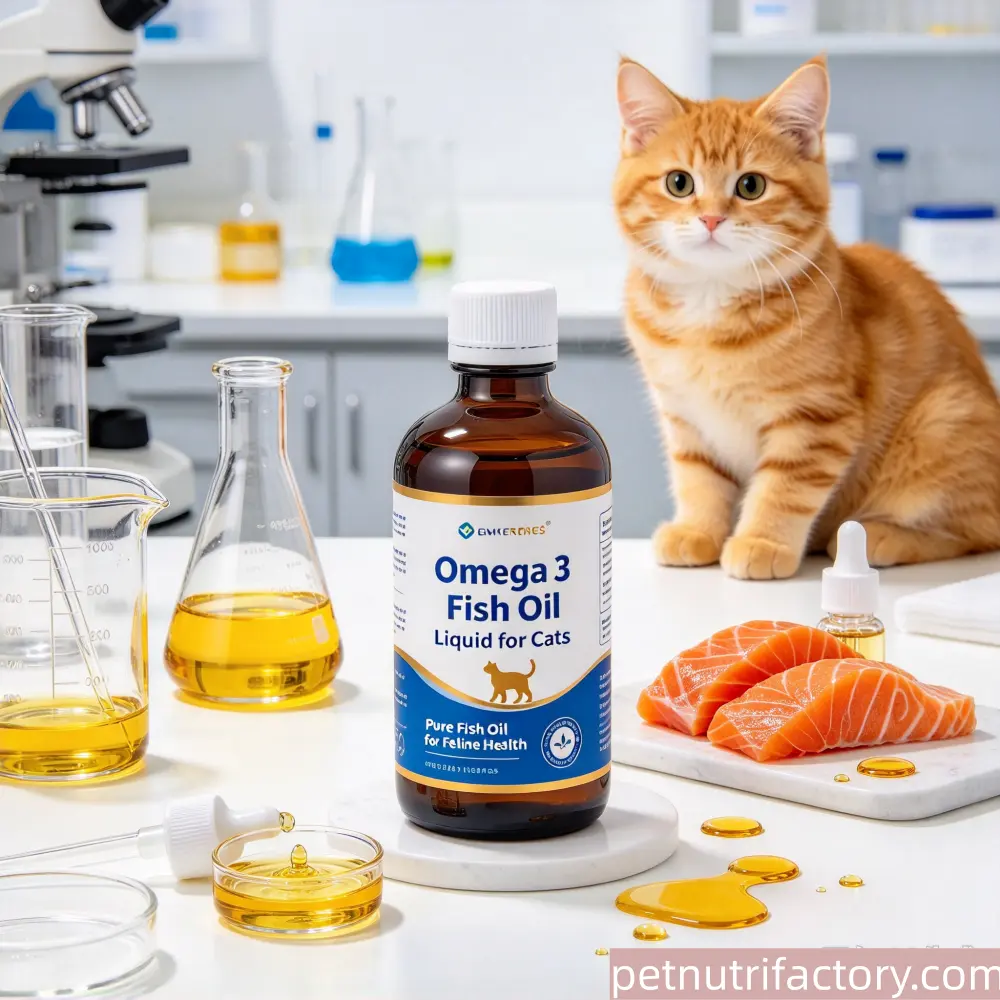
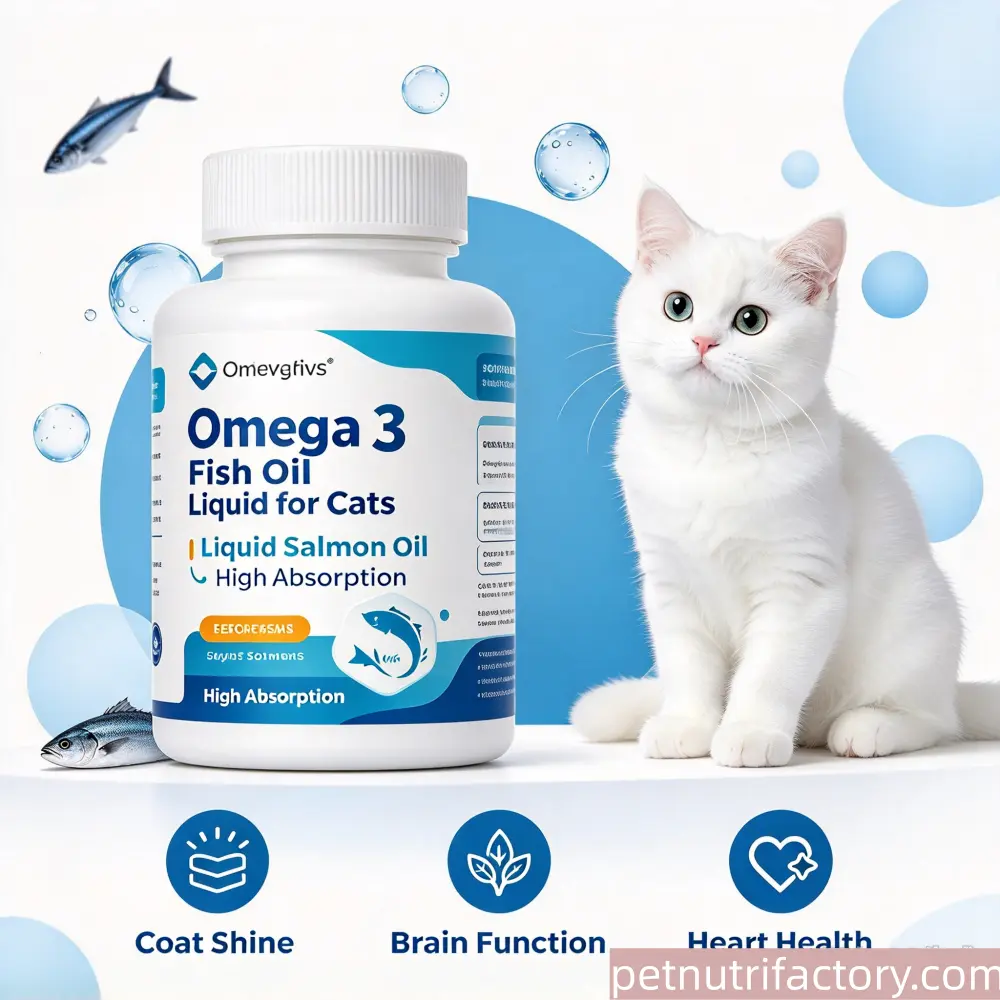
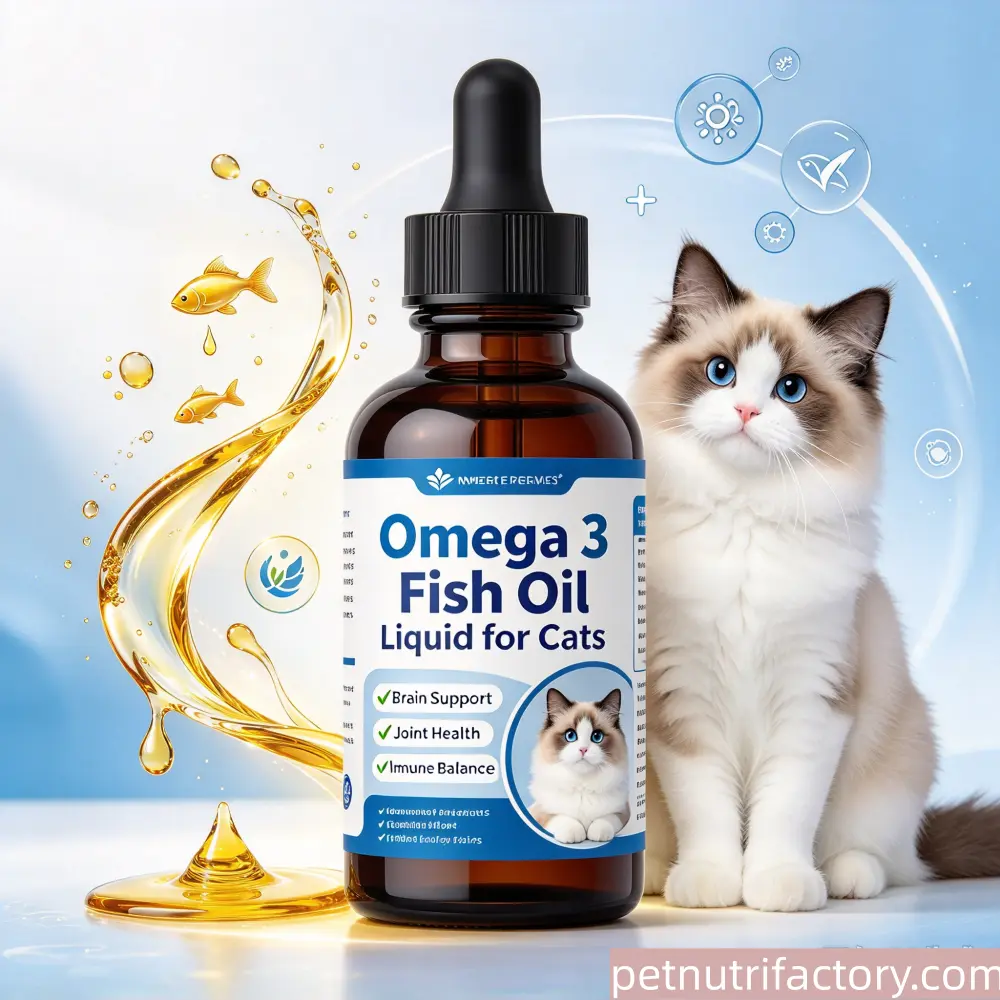
SKIN-1004 Omega 3 Fish Oil Liquid for Cats: Sunflower Lecithin Skin & Coat Formula from a Factory-Direct OEM/ODM Manufacturer
PetNutriFactory SKIN-1004 is an Omega 3 fish oil liquid formulated for cats with natural sunflower lecithin and a multivitamin blend, positioned as a skin-barrier and coat-support supplement for private label and contract manufacturing programs. This page is written for two audiences at once: cat owners researching how an Omega 3 fish oil liquid may support skin and coat condition, and brand owners, distributors, and sourcing teams evaluating a factory-direct OEM or ODM partner for a cat skin & coat liquid SKU. The formula, the dosing format, and the manufacturing path are described together because for a liquid supplement, the product and the production system are not separate questions.
Why Feline Skin and Coat Problems Are Better Addressed from Within
Excessive shedding, flaky dandruff, and dry, coarse fur are among the most common reasons cat owners search for a supplement. These signs rarely trace back to a single surface cause. The skin is an organ with an active lipid barrier, and the fur that emerges from it reflects the nutritional environment beneath. When dietary fatty acid supply is insufficient or imbalanced, the barrier loses some of its capacity to retain moisture, and the coat can lose flexibility and brightness before any obvious dermatological disease is present.
Topical shampoos and conditioners have a place, but they act on the surface and are washed away. Dietary Omega 3 fatty acids — specifically EPA and DHA — are incorporated into cell membranes and influence the inflammatory pathways that sit behind skin irritation and barrier dysfunction. A liquid skin & coat supplement is therefore not a cosmetic add-on; it is a nutritional input aimed at the structural and functional layer of the skin.
For a product to be useful in daily life, three conditions need to be met at once: the fatty acid supply must be meaningful, the formula must support the broader barrier system rather than isolate one nutrient, and the delivery format must be something a cat will actually accept. SKIN-1004 is designed against those three conditions.
SKIN-1004 Formula Logic: Omega 3, Sunflower Lecithin, and Multivitamins Working Together
The ingredient list of a supplement is not a formula. What matters is whether the components have a reason to be in the same bottle. SKIN-1004 combines fish-derived Omega 3, sunflower lecithin, and a multivitamin blend within a liquid matrix, and each component addresses a distinct layer of the same skin and coat problem.
Omega 3 Fish Oil: The Fatty Acid Foundation for the Skin Barrier
Fish oil provides EPA and DHA, long-chain Omega 3 fatty acids that cats cannot synthesize efficiently from plant precursors. In feline allergic dermatitis, cats supplemented with an oil preparation enriched in EPA and DHA showed clinical improvement after six weeks compared with an untreated control group. A separate systematic review of companion animal studies concluded that Omega 3 fatty acids should be considered for the improvement and maintenance of hair quality, with therapeutic use continuing for at least two months. These findings do not mean every cat will visibly change on a fixed schedule, but they establish the biological rationale for sustained dietary Omega 3 inclusion.
The liquid format matters here. Cats are small animals with small stomachs and strong preferences. A liquid fish oil can be measured by body weight and dispersed into wet food, which supports consistent daily intake. Consistency is the variable that most often determines whether a fatty acid supplement produces a visible change, because membrane incorporation is cumulative rather than instantaneous.
Sunflower Lecithin: A Phospholipid Source That Supports the Lipid Matrix
Sunflower lecithin is a natural source of phospholipids, the structural molecules that make up cell membranes and help organize lipids in aqueous environments. In a liquid supplement, lecithin also functions as an emulsifier, helping the oil phase remain evenly dispersed rather than separating into a layer at the top of the bottle. This is a formulation function that directly affects dose uniformity: if the oil separates, the amount of EPA and DHA delivered per pump or dropper is no longer predictable.
The choice of sunflower lecithin rather than soy lecithin is deliberate. Soy is a recognized allergen source for some animals, and a skin and coat formula intended for sensitive cats has no reason to introduce an avoidable allergen risk. Sunflower-derived lecithin sidesteps that concern while delivering the same phospholipid and emulsification functions. Published work on polyunsaturated fatty acid supplementation in cats and dogs has used lecithin together with sunflower seed oil within a mixed oil system, and reported improvements in hair flexibility, brightness, and skin condition scores at a body-weight-based daily dose. The formula architecture is consistent with that approach.
Multivitamin Blend: From “Fish Oil” to “Skin Barrier Support”
A fish oil product competes in a crowded category defined by one ingredient. SKIN-1004 is positioned differently. The multivitamin component is included to address the fact that skin barrier function depends on more than fatty acids alone — the enzymatic and antioxidant systems that maintain skin integrity require cofactors that a purified oil does not supply. By combining Omega 3 with a multivitamin blend, the formula moves the product from “fish oil for cats” to a skin-barrier support formula, which is a broader and more defensible shelf position.
This distinction matters commercially for OEM and ODM clients. A single-ingredient fish oil is a commodity. A formula with a defined skin & coat architecture — fatty acid supply, phospholipid support, and micronutrient cofactors — gives a private label brand a product story that can support premium positioning, subscription retention, and retail channel differentiation without requiring the brand to build a formulation team from scratch.
All-Natural Positioning and Clean-Label Compatibility
SKIN-1004 is formulated without artificial colors and preservatives. For a brand selling into clean-label retail, subscription DTC, or markets where additive scrutiny is high, this reduces the compliance and reformulation friction that can otherwise delay a launch. It is a formulation decision with supply-chain consequences: fewer synthetic inputs means a shorter and more auditable ingredient declaration, which in turn simplifies label review in multiple target markets.
What to Expect: A Realistic Timeline for Shedding, Dandruff, and Coat Condition
Nutritional supplements do not produce overnight changes, and a page that implies otherwise creates problems downstream — for the cat owner and for the brand. The evidence base for Omega 3 in skin and coat support points to weeks, not days. Six weeks of EPA/DHA supplementation was the point at which clinical improvement was observed in feline skin cases, and a minimum of two months has been recommended for hair quality outcomes. Cats with dry, non-pruritic skin have shown subjective coat improvement over a 12-week period in small open-label trials.
These timelines are useful for setting expectations. A cat owner should not conclude that a product has failed after ten days. A brand should not promise a visible difference within a week. The practical framing is that SKIN-1004 is a daily nutritional input intended to support normal skin barrier function over a sustained period, not a treatment for diagnosed dermatological disease. Cats with active skin disease, open lesions, or severe pruritus need veterinary evaluation, and a supplement should not delay that.
For OEM and ODM clients, this expectation management has a direct commercial value. Clear timelines in the brand’s product page, packaging insert, and customer service scripts reduce refund requests and subscription cancellations driven by unrealistic expectations. A formula with a defensible onset timeline is easier to sell repeatedly than a formula that has to be defended after two weeks.
Palatability and Administration: Why the Liquid Format Solves the “Last Meter” Problem
The most well-designed feline supplement fails if the cat refuses it. This is not a minor consumer inconvenience; it is the primary adoption barrier in the cat supplement category. Capsules must be manually administered, tablets must be crushed or hidden, and powders change the texture of food in ways that some cats reject. Each of these failure points increases the chance that the product is used inconsistently or abandoned.
SKIN-1004 is a liquid designed to be mixed into the cat’s daily meals. A measured amount can be dispersed into wet food or a favorite meal, which removes the need for restraint, pill pockets, or a separate feeding ritual. For multi-cat households, senior cats, and cats on existing wet-food diets, this is the difference between a supplement that becomes part of the routine and one that becomes a source of daily friction. Liquid formulations are also associated with high absorbability and ease of use, which are the reasons this format is favored for daily nutritional support in cats.
In B2B terms, palatability is not a “nice to have.” A private label supplement that cats refuse will generate returns, negative reviews, and subscription churn regardless of the quality of its ingredient panel. SKIN-1004 is built around a delivery format that prioritizes acceptance, because acceptance is the precondition for the repeat purchase that makes a private label SKU viable.
Why SKIN-1004 Is Built for OEM and ODM Procurement: Factory Capability and Customization Path
The first half of this page explains why the formula makes sense for cats. This section explains why it makes sense for a brand, distributor, or sourcing team to build a private label program around it with PetNutriFactory. The relevant questions at this stage are not about EPA and DHA; they are about production scope, documentation, minimum order quantities, and how much of the formula and packaging can be adapted to a specific market position.
OEM and ODM: Two Distinct Engagement Models
OEM and ODM are often used interchangeably in supplier marketing, but they describe different responsibilities. In an OEM engagement, the client provides the formula or a defined specification, and the factory manufactures, fills, and releases the product to that specification. The client owns the formulation and the factory executes it. In an ODM engagement, the client starts from an existing factory formula — in this case, SKIN-1004 — and customizes the commercial and, where appropriate, compositional elements around it: bottle size, closure type, label and language, dosage presentation, and market-specific compliance adjustments.
SKIN-1004 is structured to serve both paths. A brand with an existing skin and coat liquid formula can use PetNutriFactory as an OEM production partner. A brand without in-house formulation capability can use SKIN-1004 as an ODM starting point and reach the market with a defined skin-barrier product architecture without building a research and development function from zero. The distinction is not cosmetic: it determines who carries formulation responsibility, how change control is handled, and what documentation the client owns.
Production Scope, Quality Documentation, and What a Serious Buyer Should Verify
For liquid pet supplements, the production authorization must cover the specific dosage form. In jurisdictions that regulate pet nutritional products under feed-additive frameworks, the manufacturer’s license must explicitly include “pet additive premix feed” and the liquid form; general food or supplement certificates that do not list liquid pet supplement production are not equivalent. ISO 22000, HACCP, and GMP certifications are system-level indicators of how the facility manages hygiene, hazard control, and process consistency, and they are commonly treated as baseline requirements by experienced buyers rather than differentiators.
A buyer evaluating any liquid supplement factory, including PetNutriFactory, should ask for a specific document set rather than a list of logos: the production license with its permitted product categories and dosage forms; the current certificate of analysis for each raw material lot, including fish oil and sunflower lecithin; batch records and retention samples; and third-party test reports for finished product release where applicable. The ability to produce these documents on request is a more meaningful signal than the presence of a certification mark on a homepage. The relevant question is not “are you certified” but “can you show me the scope of the certificate and the batch-level records behind this SKU.”
MOQ, Lead Time, and Customization Parameters
Liquid supplement manufacturing has an economic floor. Industry benchmarks for private label liquid pet supplements commonly start at 1,000 bottles with lead times in the four-to-six-week range once formula and label are approved, while larger-format or higher-volume programs may start at 2,500 to 5,000 units. These figures are directional, not universal: actual MOQ and lead time depend on bottle size, closure type, filling line configuration, label approval, and the client’s target market documentation requirements.
The customization variables that matter most in a liquid skin and coat SKU are packaging and presentation. Bottle material and volume, pump versus dropper versus dosing cup, label dimensions and multilingual layout, and carton configuration all affect both the unit economics and the shelf impression. PetNutriFactory’s production scope covers liquid filling and packaging for private label pet supplements, and the practical starting point for a serious inquiry is a specification conversation: target bottle size, target daily dose, target market, and expected first-order volume. MOQ, tooling requirements, and lead time follow from those inputs. A supplier that quotes a price before understanding the packaging and dose specification is not giving a usable quote.
SKIN-1004 as an Entry Point to a Broader Cat Supplement Line
A single SKU is rarely the objective of a private label program. SKIN-1004 is positioned as an entry point into a cat supplement range that can extend into adjacent liquid or semi-solid formats — joint support, calming, digestive and probiotic, and multivitamin lines — using the same production and documentation infrastructure. For a brand, this means the supplier qualification effort, the packaging component relationships, and the quality documentation framework can carry across multiple SKUs rather than being rebuilt for each product. A factory that can grow with the brand’s catalog is more valuable over a three-year horizon than a factory that can only execute one formula at a competitive price.
Sample, Quotation, and Next Step
SKIN-1004 is available for OEM and ODM evaluation as a cat skin and coat liquid supplement with a defined Omega 3, sunflower lecithin, and multivitamin architecture. Brands, distributors, and sourcing teams can request a sample for palatability and stability assessment, and request a quotation based on target bottle size, dose specification, packaging format, and first-order volume. The full SKIN-1004 technical specification sheet, including ingredient declaration, proposed dosage, and available packaging formats, is available on request. To begin, contact PetNutriFactory with your target market and packaging requirements, and the team will respond with the specification documents and a quotation framework tailored to your program.
Other product you may like
The Most Popular Custom Pet Nutritional Supplements from a Leading Chinese Manufacturer