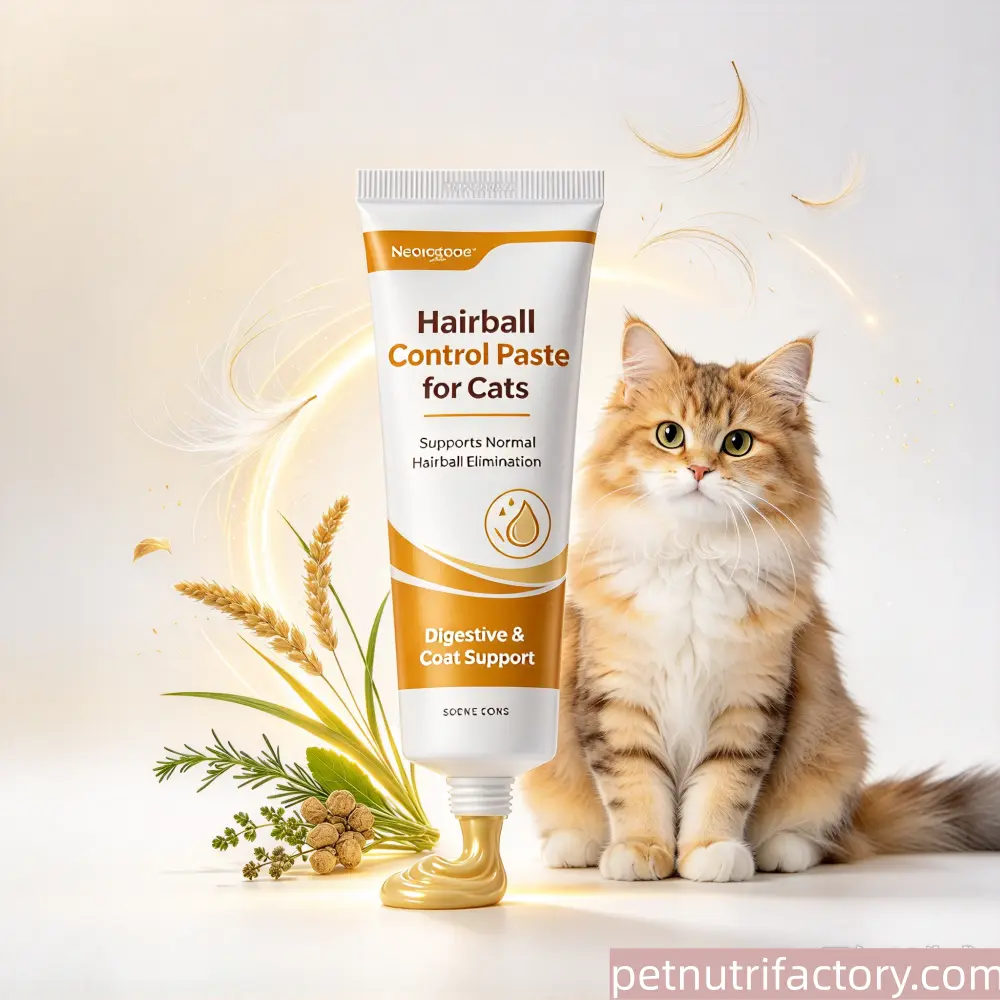
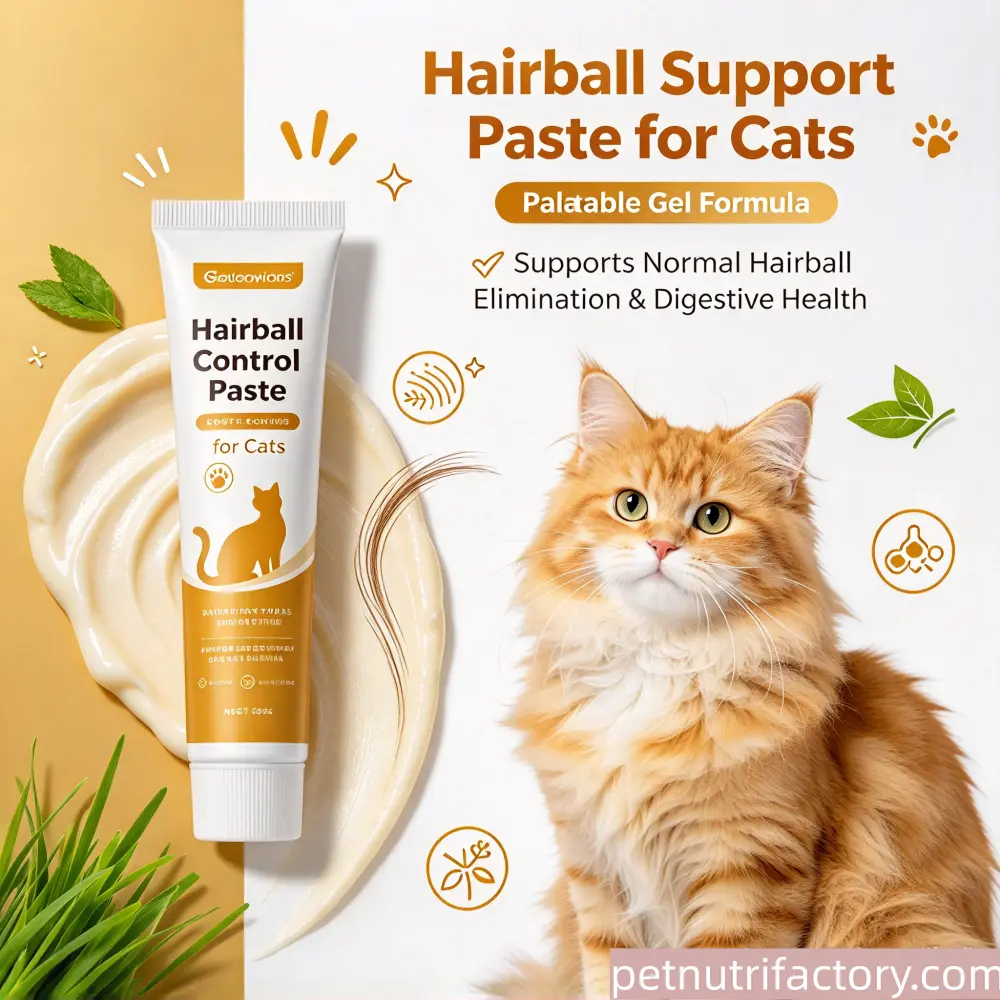
Hairball Control Paste for Cats
- Model No.: SKIN-1007
- Product Name: Hairball Control Paste for Cats
- Supports natural intestinal peristalsis to help cats expel ingested hairballs
- Reduces vomiting and discomfort caused by accumulated hairballs
- Enriched with natural sunflower lecithin to nourish skin and coat
- Helps cut down excessive shedding and flaky dandruff
- All-natural formula, free from artificial colors and preservatives
- Tasty paste texture, easy to feed directly or mix with cat food
Customization Services
- Custom Formula & Raw Material Selection for diverse pet health and nutritional requirements
- Personalized flavor, color and graphic design to fit your brand positioning
- Custom dosage and potency for targeted pet groups and market levels
- Private label logo printing & custom packaging surface treatment
- Custom product shape, specification and packaging solution to boost brand image
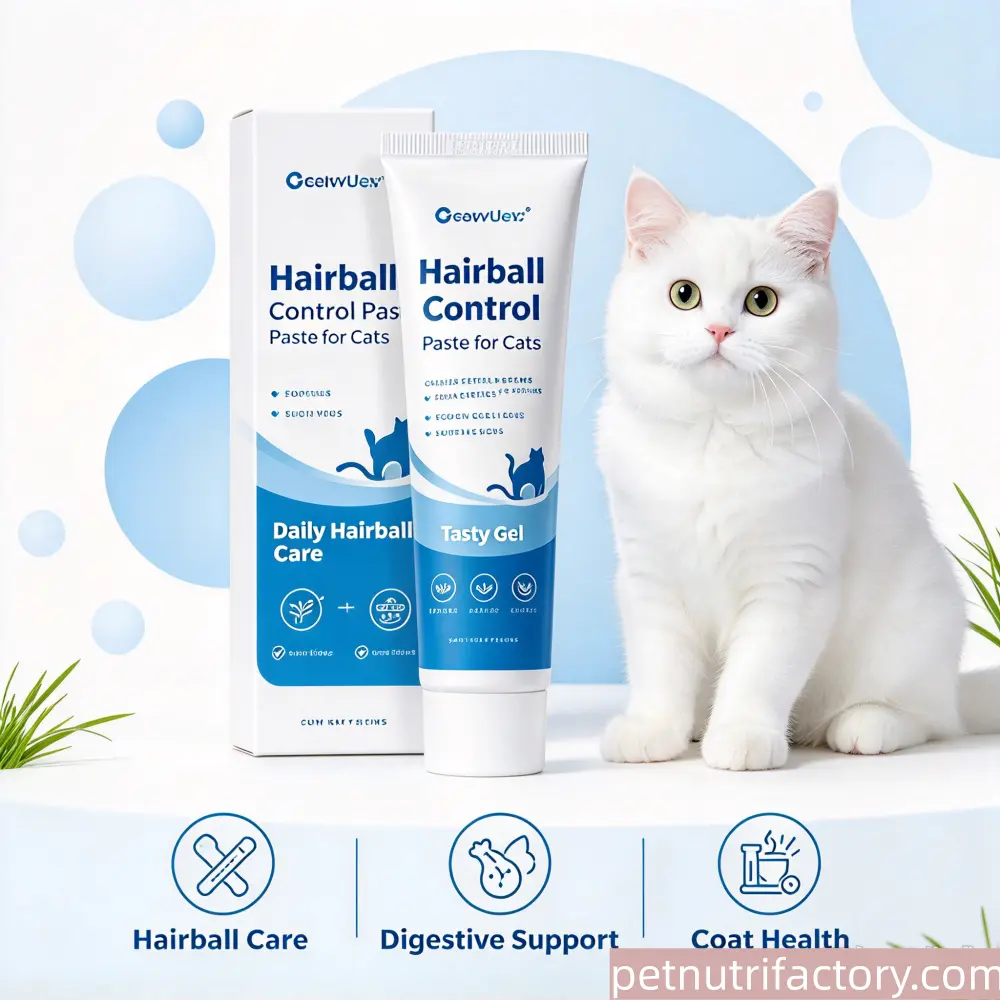
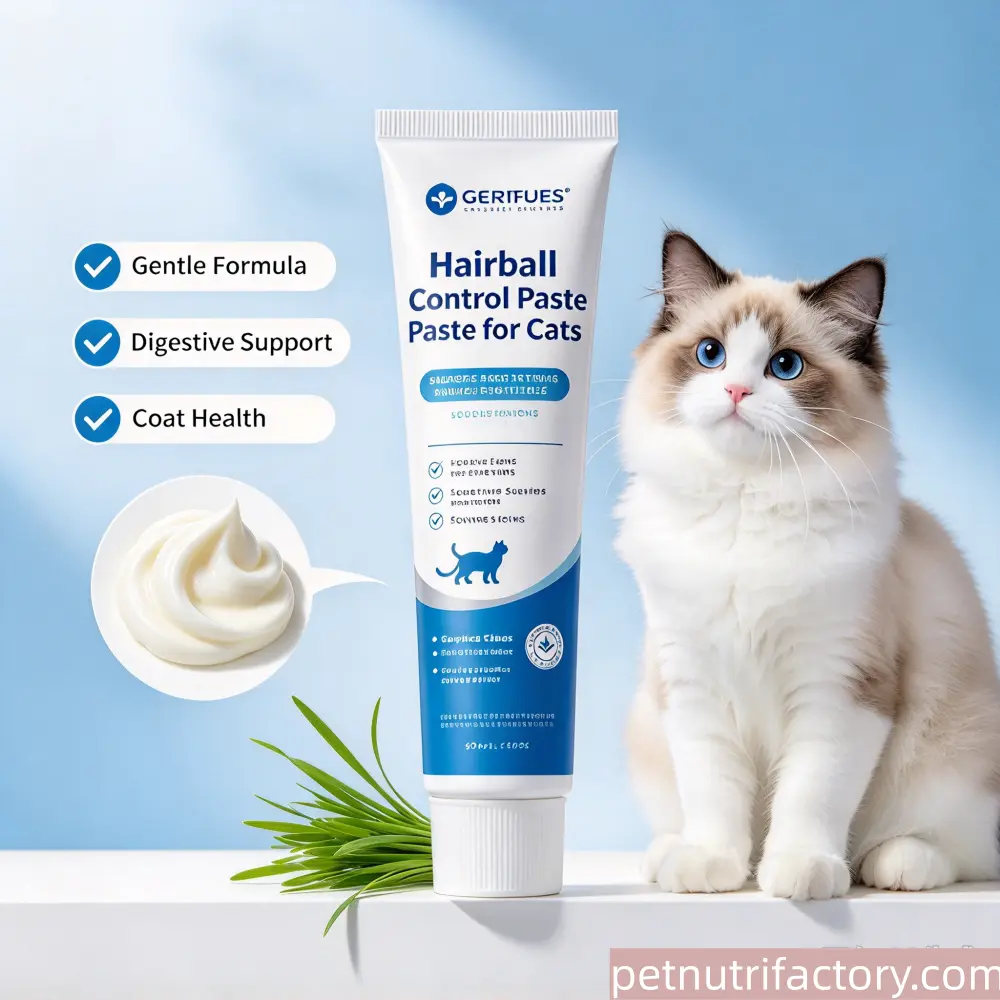
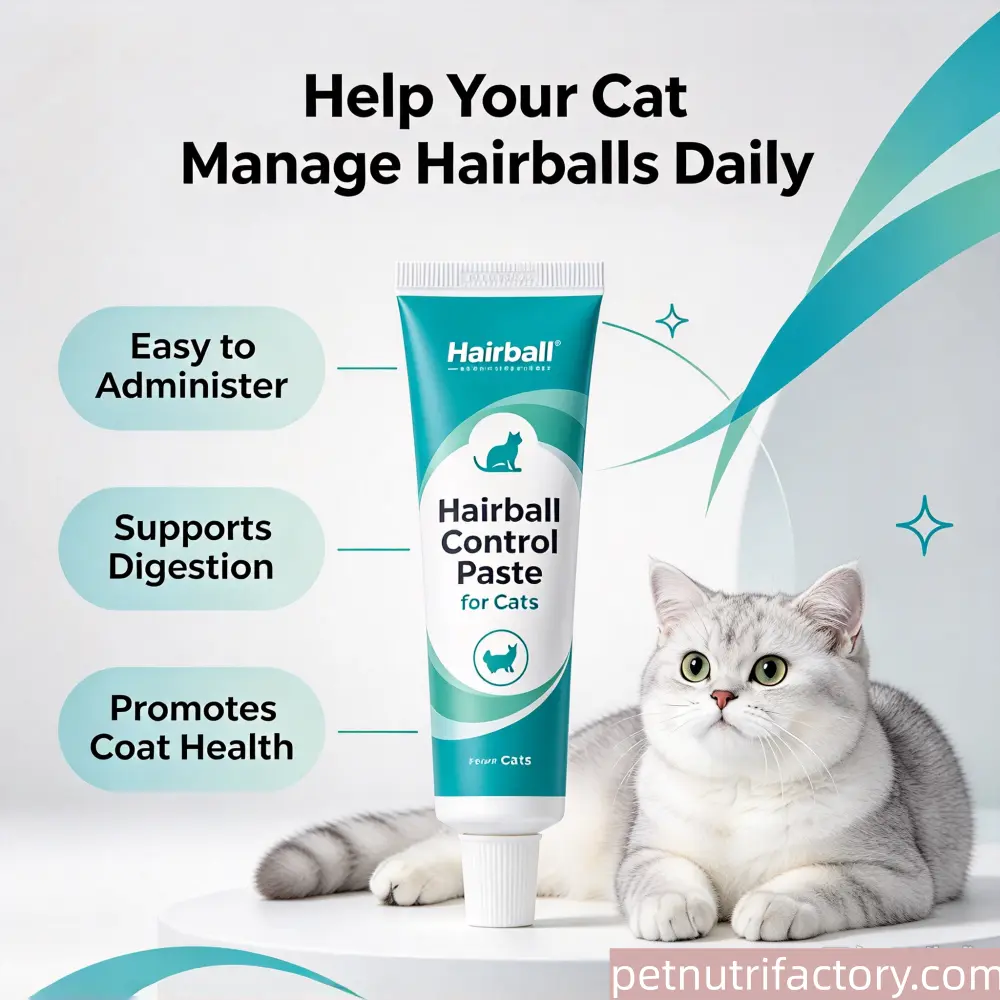
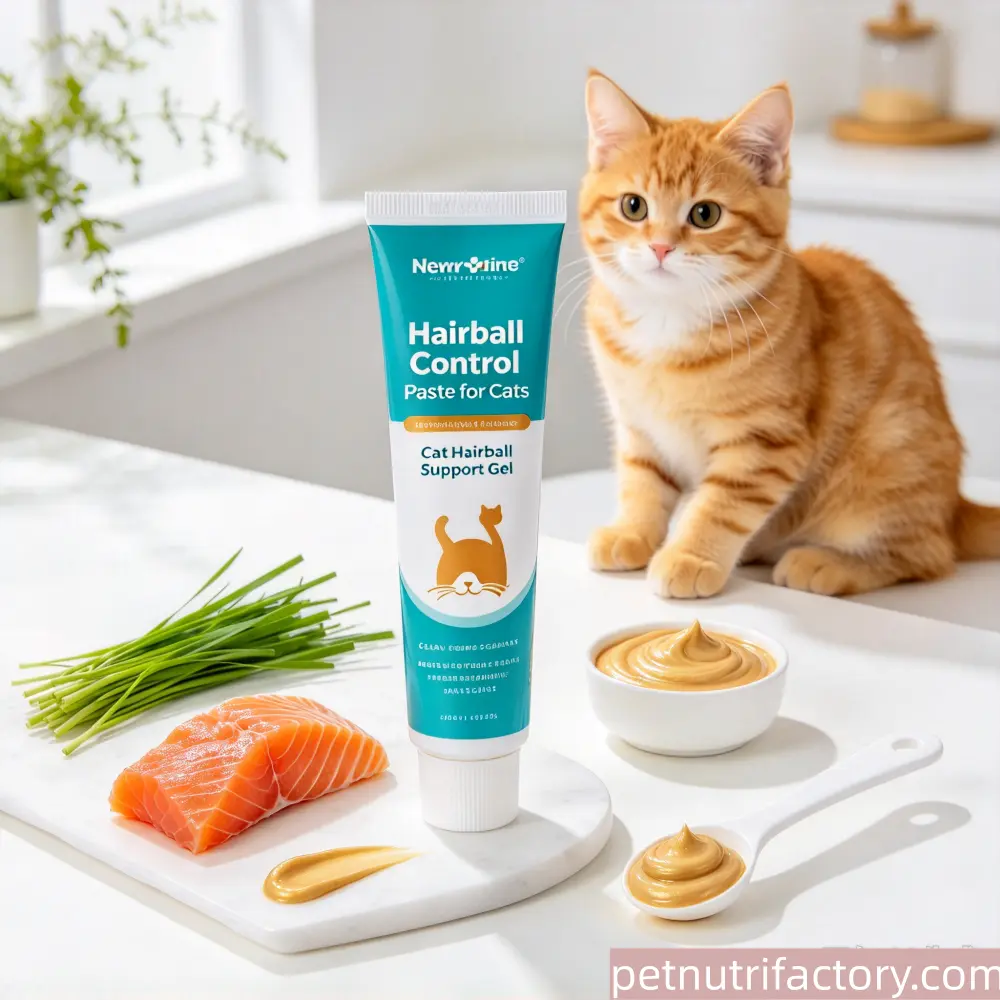
SKIN-1007 Hairball Control Paste for Cats: Sunflower Lecithin Formula from a Factory-Direct OEM/ODM Manufacturer with Batch-Level Quality Testing
PetNutriFactory SKIN-1007 is a hairball control paste for cats formulated with natural sunflower lecithin, positioned as a dual-action digestive and skin-coat support supplement for private label and contract manufacturing programs. The formula supports natural intestinal peristalsis to help cats expel ingested hair, while the sunflower lecithin component addresses the skin and coat side of the hairball cycle — excessive shedding and flaky dandruff are upstream inputs to the hair a cat swallows during grooming. This page serves two audiences: cat owners looking for a palatable hairball remedy paste that is easy to administer, and brand owners, distributors, and sourcing teams evaluating a factory-direct OEM or ODM partner for a cat hairball control SKU. The second half of the page is written specifically for the procurement decision, including the quality documentation and batch testing practices that separate a usable private label supplier from a trading company with a product photo.
Why Hairballs Are a Digestive Problem and a Skin and Coat Problem at the Same Time
Cats groom with precision. The same diligence that keeps the coat clean and soft also means a daily intake of loose hair, and that hair can accumulate in the stomach or intestine into dense masses that affect comfort and health[reference:3]. The risk rises during seasonal coat changes and in long-haired breeds, but short-haired cats are not exempt[reference:4]. The visible outcomes are familiar: retching, vomiting, reduced appetite, and in more serious cases gastrointestinal obstruction.
Most hairball products address one end of this cycle. They lubricate the digestive tract so that ingested hair passes more easily. That is necessary, but it leaves the source of the hair unaddressed. The volume of loose hair a cat swallows is a function of shedding rate and coat condition, and both of those are influenced by skin barrier health. A formula that only lubricates treats the symptom downstream while the upstream supply of hair continues. SKIN-1007 is designed around both ends: a paste matrix that supports the passage of hair through the gut, and a phospholipid component that supports the skin and coat condition that generates the hair in the first place.
For a private label brand, this dual positioning has practical value. A single-function hairball paste competes on price and texture. A hairball control paste that also carries a skin and coat benefit gives the brand a broader reason-to-buy, a wider set of search terms to rank for, and a product story that holds up on a shelf next to both hairball products and skin-coat supplements.
SKIN-1007 Formula Logic: A Two-Path Approach to Hairball Management
Path One: Supporting Natural Intestinal Peristalsis
The first function of a hairball paste is mechanical and physiological: help the hair move. Dietary fiber sources stimulate natural intestinal peristalsis and support the passage of swallowed hair[reference:5][reference:6]. Oils and lubricating bases coat the hair strands, preventing them from massing into a compact ball and supporting their transit through the gastrointestinal tract[reference:7][reference:8]. This is why veterinary references describe oil-based digestive lubricants as a standard approach to preventing and eliminating hairballs in cats. SKIN-1007 is formulated as a palatable paste that delivers this lubricating and peristalsis-supporting function in a format a cat will voluntarily lick from a tube or accept mixed into food.
Path Two: Sunflower Lecithin for Skin and Coat Support
The inclusion of natural sunflower lecithin distinguishes SKIN-1007 from a conventional malt or petroleum-based hairball paste. Sunflower lecithin is a phospholipid source that supports the lipid matrix of the skin, and it appears alongside Omega-rich oils in hairball and skin-coat formulas positioned for cats with dry, flaky skin or excessive shedding[reference:10]. In a paste format, lecithin also contributes to a smooth, uniform texture that supports consistent dosing from a tube — a formulation detail that matters for both palatability and dose accuracy.
The strategic logic is straightforward. If the paste helps reduce excessive shedding and supports a healthier coat, the cat grooms out less loose hair, and the total hair load entering the digestive tract declines. The two paths compound: less hair in, easier hair out. A hairball control paste that only does the second half of this equation asks the consumer to buy a separate skin and coat product. SKIN-1007 closes the loop in one SKU, which is a cleaner proposition for a private label brand building a focused cat supplement range.
All-Natural Positioning and Palatability as a Formulation Requirement
SKIN-1007 is formulated without artificial colors and preservatives. The paste texture is designed for direct feeding or mixing with cat food, which removes the administration friction that causes supplements to be used inconsistently. In the hairball category, palatability is not a marketing preference; it is the precondition for the product to be given often enough to work. Cats that reject a paste do not receive a second dose, and a private label SKU that generates refusal complaints does not survive its first reorder cycle. The paste format is chosen because it aligns the cat’s acceptance behavior with the owner’s dosing intention.
What to Expect: Onset, Dosing Rhythm, and the Limits of a Nutritional Paste
Hairball pastes are not slow-acting supplements in the way an Omega 3 skin formula is. Veterinary guidance for oil-based digestive lubricants indicates that the product should take effect within one to two days, with improvement in clinical signs following. Published product protocols for hairball removal pastes commonly use a short loading phase followed by a maintenance frequency, and some veterinary references describe stopping administration when hairball expulsion is no longer observed within a five-day window[reference:12]. These are directional parameters that a brand should adapt to its own formula and target market claims, but they establish the practical rhythm: a hairball paste is used episodically for active hairballs and periodically for prevention during shedding season.
Expectation management matters in this category because the word “remedy” invites the assumption of a cure. A nutritional paste supports normal digestive transit and coat condition; it does not treat an obstruction, and cats with persistent vomiting, anorexia, or lethargy need veterinary evaluation rather than another dose of paste. The regulatory framing in many markets reinforces this: non-drug health products for pets are not reviewed by the FDA for safety or effectiveness before sale, and labels are expected to carry the standard statement that the product is not intended to diagnose, treat, cure, or prevent any disease. A brand that builds its product page and packaging around a realistic, compliant claim set reduces regulatory friction and returns simultaneously.
Why a Factory-Direct OEM/ODM Partner Matters for a Paste Product
A hairball paste is not a capsule filled from a bought-in powder. It is a formulated semi-solid with texture, mouthfeel, tube-flow behavior, and stability requirements that interact with every ingredient in the matrix. The difference between a paste that dispenses cleanly and one that separates in the tube, or between a paste a cat licks willingly and one it refuses, is usually a formulation and process question — not an ingredient-list question. This is why the supplier relationship matters more in the paste category than it does for a simple dry supplement, and why PetNutriFactory positions SKIN-1007 as a manufacturing program rather than a catalog item.
OEM and ODM: What Each Path Covers for SKIN-1007
In an OEM engagement, the client supplies the formula or a defined specification, and PetNutriFactory manufactures, fills, and releases the paste to that specification. The client owns the formulation; the factory owns execution and documentation. In an ODM engagement, the client starts from the SKIN-1007 formula architecture — sunflower lecithin plus a peristalsis-supporting paste base — and customizes the commercial and, where appropriate, compositional parameters: tube size and material, closure type, label and language, flavor direction, and market-specific claim adjustments. A brand without in-house formulation capability can reach the market with a defined dual-path hairball and skin-coat product without building a paste development function from zero. The distinction determines who carries formulation responsibility, how change control is documented, and what the client ultimately owns.
Batch-Level Quality Testing and Documentation: What “Quality Control” Actually Means
Certifications are a starting point, not a quality system. ISO 22000, HACCP, and GMP indicate that a facility has a management framework for hygiene, hazard control, and process consistency, and they are baseline expectations for any serious buyer[reference:14]. What distinguishes a supplier in practice is whether those frameworks produce batch-level evidence that a buyer can open, read, and verify. For a paste product, that evidence set has several specific components.
Raw material COA and traceability. Every incoming lot of sunflower lecithin, oils, fiber sources, and other functional ingredients should carry a certificate of analysis from the supplier, and the factory should be able to link the finished batch to those incoming lots. A supplier that cannot trace a finished tube back to a raw material lot has a documentation gap regardless of what certification marks appear on its website.
Batch-level finished product testing. The relevant testing scope for a pet paste includes microbial screening for Salmonella, E. coli, and Listeria monocytogenes, and heavy metal analysis. A COA issued per batch, rather than a single certificate of analysis from a historical production run, is the document that tells a buyer what was actually tested and released. PetNutriFactory’s quality documentation is structured around per-batch COA support and full traceability, with third-party verification available for finished product release[reference:16].
Retention samples and batch records. A factory that retains samples from each batch and can produce batch records on request is a factory that can investigate a complaint rather than merely respond to it. For a brand selling into retail or subscription channels, this is the difference between a supplier that helps resolve a quality event and one that leaves the brand exposed.
The practical instruction for a buyer is not to ask “are you certified” but to ask for the document set behind a specific SKU: the production license with its permitted dosage forms, the raw material COA for the current lots, a finished-product COA from a recent batch, and a sample batch record. A supplier that answers those requests with specific documents is a different category of partner from one that answers with a logo wall.
Paste Filling, Tube Packaging, and the Customization Variables That Drive Cost
The unit economics of a hairball paste are shaped by the tube as much as by the formula. Paste filling lines are configured for specific tube diameters and fill weights, and the closure type — screw cap, flip-top, or nozzle — affects both the filling process and the user experience. Tube material selection, label dimensions and multilingual layout, and carton configuration all sit on the same cost curve. Industry benchmarks for private label paste programs vary widely by format: some suppliers quote MOQs in the hundreds of tubes for a 120 g format, while tube component minimums for customized laminated tubes can start in the low thousands[reference:17]. The honest answer to “what is your MOQ” is therefore conditional: it depends on tube size, whether the tube is a stock or custom component, label approval, and target market documentation requirements.
PetNutriFactory’s production scope covers paste filling and tube packaging for private label pet supplements. The productive starting point for a serious inquiry is a specification conversation: target tube size and fill weight, daily dose and dosing format, target market and claim requirements, and expected first-order volume. MOQ, tooling implications, and lead time follow from those inputs. A quotation issued before those variables are settled is not a usable quotation, and a supplier that offers one is signaling that it has not understood the product.
SKIN-1007 as an Entry Point to a Cat Digestive and Skin-Coat Range
A hairball control paste sits at the intersection of two larger cat supplement categories: digestive support and skin and coat support. SKIN-1007 is positioned as an entry point into a range that can extend into adjacent paste, liquid, and semi-solid formats — digestive and probiotic pastes, skin and coat liquids, calming pastes, and multivitamin lines — using the same filling infrastructure, tube component relationships, and quality documentation framework. For a brand, this means the supplier qualification effort and the packaging supply chain are not rebuilt for each new SKU. A factory that can carry a brand’s catalog across multiple adjacent products is more valuable over a multi-year horizon than one that can execute a single paste at a competitive unit price.
Sample, Quotation, and Next Step
SKIN-1007 is available for OEM and ODM evaluation as a cat hairball control paste with a dual-path formula combining peristalsis support and sunflower lecithin skin-coat nourishment. Brands, distributors, and sourcing teams can request a sample for palatability and tube-flow assessment, and request a quotation based on tube size, fill weight, packaging format, target market, and first-order volume. The full SKIN-1007 specification sheet, including ingredient declaration, proposed dosing, available tube formats, and the batch-level COA and testing documentation available for review, is provided on request. To begin, contact PetNutriFactory with your target market and packaging requirements, and the team will respond with the specification documents and a quotation framework tailored to your program.
Other product you may like
The Most Popular Custom Pet Nutritional Supplements from a Leading Chinese Manufacturer